Getting to Know Ronald Reagan Better

Getting to Know Ronald Reagan Better

Getting to Know Ronald Reagan Better

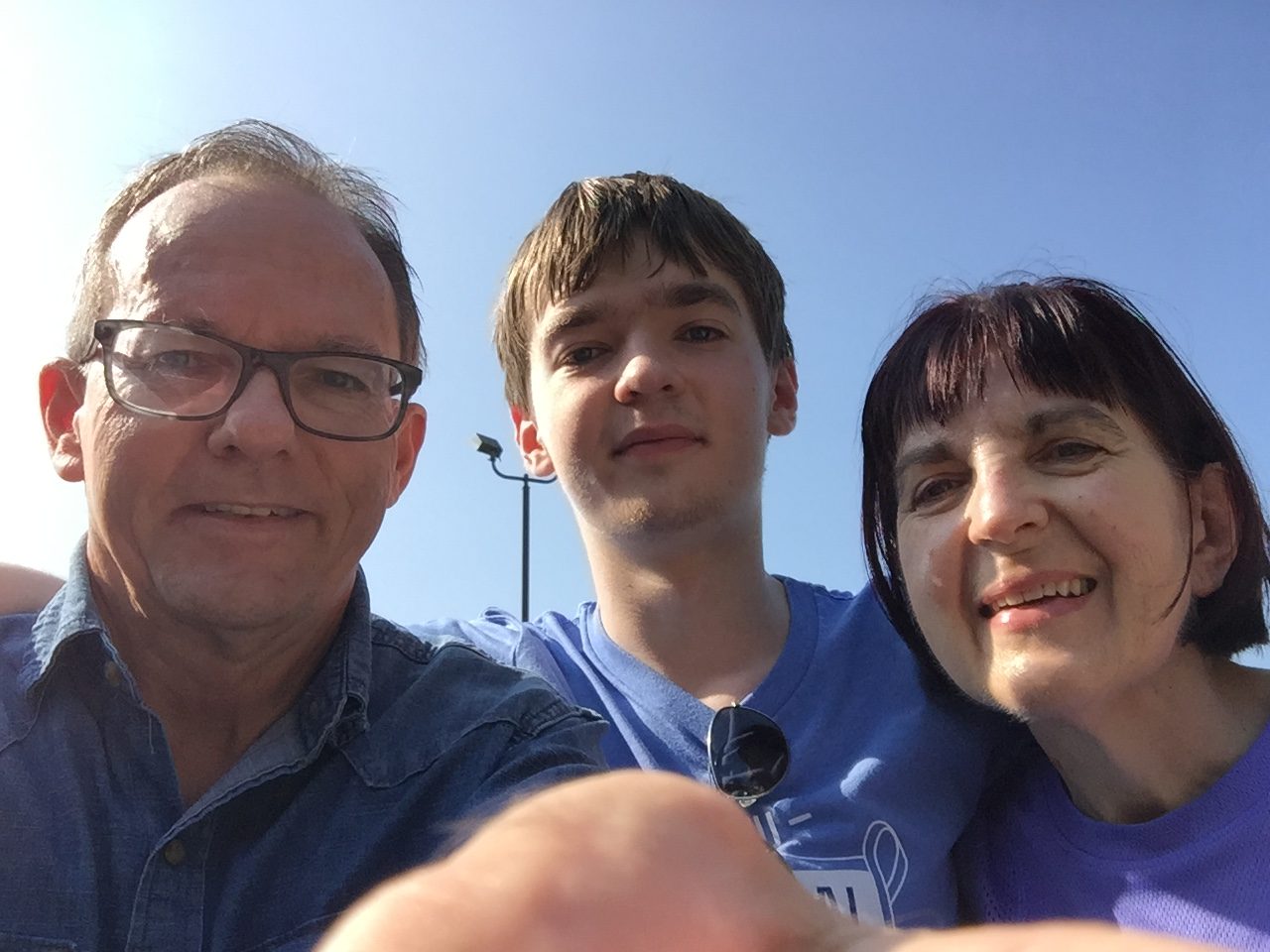
Standing next to the Berlin Wall Obelisk

In my university days in South Africa, the name of Ronald Reagan, recently elected as President of the USA, always brought about the image of a genial, sincere, kind man. A good friend once said that he would perhaps be the last of the great American presidents.

On a visit to California earlier in the year, my good friend Anthony Russo and I had the opportunity to visit the Ronald Reagan Presidential Library and Museum, located in Simi Valley, some miles north of Los Angeles. It was a short and easy drive from where we were staying in Van Nuys in readiness for attending and exhibiting (and selling books for Shepherd Press) at the Shepherds’ Conference.

My thinking was that an hour or two would be sufficient for the visit. I could not have been more mistaken. Arriving shortly after 10am, by 4pm we were still enraptured by all there was to see and think about.

As the museum’s website well states, “Perched on a mountaintop with sweeping views of the surrounding mountains, valleys and the Pacific Ocean, the Ronald Reagan Presidential Library is one of California’s most beautiful and unique destinations.” It continues, “The Ronald Reagan Presidential Library and Museum is an immersive museum-going experience. More than twenty galleries highlight the life and times of America’s 40th president. The Reagan Library also presents entertaining and informative temporary exhibitions on a wide range of subjects.”

From actual Reagan memorabilia through hologram 3D cinematic experiences, the offerings to visitors proved to be engaging and fascinating. Of particular interest were the exhibits showing how President Reagan was transported–whether in Airforce One (a retired Boeing 707–and there’s a story in itself all about that, given how the aircraft had to be dismantled, transported by road, and reassembled on site), Navy One, or other vehicles such as the presidential limousine.

Other exhibits include

  • Foundations of a Leader
  • Evolution of the Great Communicator
  • Governor of California
  • Victory and Inauguration
  • Assassination Attempt
  • The Oval Office
  • The White House
  • The First Lady
  • Rebuilding America
  • Berlin Wall
  • Peace through Strength
  • Honoring American Heroes
  • Camp David and Rancho del Cielo
  • The Post-Presidency
  • Mourning Ronald Reagan

Reagan embraced a fundamentally Western and biblically integrated worldview. He may have had unfavorable influences in some of his thinking, but his optimism, his commitment to a thoroughgoing work ethic, his power of persuasion over friends and foes alike (think of his most memorable line: “Mr. Gorbachev: Tear down this wall!”) and his concern for the greatness of the American way of life underline his presidency with a sense of remarkable success.

This slideshow requires JavaScript.

Posted by Jim Holmes in Creativity and Aesthetics, Family and Friends, Reflections, Technology, Travel, Windows on My Work, Worldview, 0 comments
Holmes Christmas Greetings, 2021

Holmes Christmas Greetings, 2021

Holmes Christmas Greetings, 2021

FULLNESS

Many years ago, a godly man named Athanasius went head-to-head with a contemporary, Arius, an influential person in the church. It involved their different views on a Greek term, homoousios or homoiousios —the matter was relative to whether Jesus, as the Son of God, was of the same or only a similar essence to the Father. Arius took the weaker position, that Jesus was similar in essence to the Father, but not that He was the same. The ensuing discussion and debate went on for a long time but, in the end, through the perseverance of Athanasius, truth prevailed. Christianity embraced the biblical position that Jesus is God. So, in Paul’s letter to the Colossians, 1:18, 19, we read that Jesus “is the head of the body, the church: who is the beginning, the firstborn from the dead; that in all things he might have the preeminence. For it pleased the Father that in him should all fulness dwell.” Later in the letter, 2:9, Paul states that “in him dwelleth all the fulness of the Godhead bodily.”

To be the perfect Savior of sinners, Jesus has to be fully God and fully human. The New Testament assures us that this is so! The hymn well says: “On Him Almighty vengeance fell | That must have sunk a world to hell | He bore it for a chosen race | And thus became their hiding place.”

Are you trusting the God-man who came into this world to save sinners just like you?


View our family newsletter in pictures HERE


NEWS UPDATE AT A GLANCE

This has been a year of change for us. Matthew completed high school at Bob Jones Academy and graduated in May. This past semester, he has been a freshman at Bob Jones University, studying cinema production.

We were able to have a few enjoyable days of vacation in Georgia in August before Matthew started college.

Jim’s mom, Jean Holmes, passed away in June. She was ninety-four years of age and living in England at the time.

Jim has kept busy with many publishing projects. Sue has had various health issues to navigate and so has worked mostly from home this year, helping Jim with editing projects and doing some work for Dr. Joseph Pipa at Greenville Presbyterian Theological Seminary.

We send you our love and best wishes for 2022.

Posted by Jim Holmes in Family and Friends, Gospel, Memories, Spirituality, Windows on My Work, Worldview, Writing, 2 comments
Introducing Coffeetime in All Seasons

Introducing Coffeetime in All Seasons

Coffeetime in All Four Seasons

An ongoing project in recent years has involved working with Roger Ellsworth on the preparation and presentation of daily Bible meditations or reflections. The project originated as we discussed an idea he had–and which speedily morphed from a single, standalone volume to several more, and, quickly after that, into a reading for each day of the year.

We’re pleased to say that we now have a new format for these delightful readings–four seasonal books that gather all of the months of the year into the four seasonal categories: Winter, Spring, Summer, and Autumn.

The creative energy that has gone into developing this series of books has been considerable. We are passionate that you will enjoy using and sharing these excellent resources.

Enjoy viewing the introductory video here!

There’s another video you could also view HERE that introduces the Autumn readings.


For more information, visit www.mycoffeecupmeditations.com or click HERE.

Posted by Jim Holmes in Creativity and Aesthetics, Family and Friends, Gospel, Publishing Books Today, Reflections, Spirituality, Theology, Windows on My Work, 0 comments
Jean Alison Holmes: Notes from Her Younger Daughter

Jean Alison Holmes: Notes from Her Younger Daughter

Jean Alison Holmes: Notes from Her Younger Daughter

A Guest Post by Janet E. Green

Jean was born on 29th January 1927 in Nakuru, Kenya. Her parents, Gertie and William Robb were among a number of intrepid pioneers who were encouraged by the British Government to go out to Africa to develop one of their colonies – Kenya, British East Africa.

There was no aid given by the British Government, so those who decided to seek a life of adventure and hopefully a better life than what was on offer in Britain at the time, had to rely on their own resources. Some of the people were wealthy – there were a number of rich British aristocrats who moved the Kenya at that time, who subsequently behaved very badly! (White Mischief). But the majority of people didn’t have a lot of money and had many challenges with which to deal when they settled and made a life for themselves in that beautiful country.

Jean was an only child and she was born when William was working in the Muhoroni area. There was very little infrastructure there and Gertie had to go and stay with friend in Nakuru when her due date got close, because there was a decent enough hospital there. After the birth Gertie and Jean went back to Muhoroni.

It wasn’t a very healthy area in which to live and Gertie often succumbed to Malaria, whereas William seemed to be immune. Kenya was full of wild animals in all areas in those days, but Muhoroni was known for snakes, and very poisonous ones at that! One of William’s colleagues was caught by a python when walking out in the bush. Pythons aren’t poisonous of course, they catch their prey and constrict the life out of them and then swallow them! The man who was caught managed to grab the tail of the python and hung onto it for dear life, so it couldn’t squeeze the life out of him, and he yelled for help. A couple of hours later someone heard him and came to his rescue. He survived, but according to the story, there wasn’t an inch on his body that wasn’t bruised and he was hoarse from shouting!

Jean was about two years old when she got malaria and she very nearly died because it was a bad bout and there wasn’t a lot of medical help in Muhoroni. It was not very long after that when they decided to move to a more healthy environment and ended up in Ol Joro Orok for a couple of years. It was when Jean was about six years old that they moved to Ol Viron. William was tasked by his employer to develop a farm out of the virgin land and they lived in a shack while a little wooden house was constructed for them to live in. (William had to build that as well!)

Jean was about six years old by then, and remembered the place clearly. They lived in a thatched wooden house with an outside loo of course. It was all very basic, they grew their own vegetables, and William had to shoot for the pot to keep them going. And then there were the normal challenges of that period – people had to be very careful that their dogs were not taken by a leopard while out walking, or, more commonly, taken off the veranda at night. During the hours of darkness their dustbins were often raided by hyena, and they could be quite aggressive (especially if you met them when going out to the loo!). Jean also remembered that when the cows were brought in from where they were grazing, sometimes a buffalo would get caught up in the herd and arrive on the farm, where it would cause a bit of chaos before running back to its own kind!

But it was a wonderful place in which to have her childhood. She could run free and wild in all the space they had, and the Subukia Valley, part of the Great Rift Valley, was the backdrop to their farm. And there were beautiful birds and Colobus and Sykes monkeys in the trees; while you almost always saw game while out walking – antelope of many varieties, zebra and giraffes.

Later William and Gertie bought Ol Orien Farm, which was very close to Ol Viron, and they developed it from scratch. After Jean married Reg in 1948, they took over the running of Ol Orien. They all lived on the farm, in two houses that William and Reg built. (It was on Ol Orien where I was brought up together with my siblings, Margaret and Jim).

They settled for a short while in Rhodesia, and then Reg was offered a job with FAO in Iraq, so they set off for the Middle East, and to a life as different as you can imagine from farm life in Kenya!

When they returned from Iraq they settled in Botswana for a while where Reg had secured a job in the dusty town of Selebi Pikwe, looking after machinery that was used for the mine. After that they moved to Swaziland and ultimately on to South Africa where they lived for many years.

They eventually bought a plot of land at Monteseel in Kwa Zulu Natal, overlooking the Valley of a Thousand Hills. (Not as majestic as the Great Rift Valley, but very beautiful, nonetheless).  They camped on the plot while they built a house for themselves and Jean created a beautiful garden. They lived there for many years and only moved to England after their three children had left for Britain.

They bought a house in Darlington not too far from their son, and settled down to life in England, very different to anything they had previously experienced! After Reg died Jean continued to live in Darlington for a while and then she came to live with me in Minster Lovell.

We moved together to Truro in Cornwall and lived there for ten years, before finally moving to Bidford on Avon.

In every place she lived, Jean made a home, a garden and then energised the place with her indomitable spirit and vigour. Like so many of the other Kenyans of her generation, she was tough and feisty and worked pragmatically through all adversity.  She had a wonderful sense of humour and loved her cats, dogs and every animal that came to her. She was a voracious reader and read anything she could get her hand on. When she was younger and her eyesight was still good, she used to knit a lot. Jumpers and jerseys for everyone! She used to read and knit at the same time while listening to the radio, because for many years she had no access to a television! And there was always a cat on her lap and a dog by her feet!

Featured Image: Flamingoes, possibly pictured at Lake Nakuru

Posted by Jim Holmes in Family and Friends, Guest Post, Reflections, Travel, Writing, 0 comments
Rev. Steve Martin Reviews “The Man in the Gap”

Rev. Steve Martin Reviews “The Man in the Gap”

Rev. Steve Martin Reviews “The Man in the Gap”

My good friend, Steve Martin, kindly allowed me to use the following book review as a guest post.


SHORT REVIEW OF REX JEFFERIES, THE MAN IN THE GAP

 (The Life and Ministry of Martin Petersen Holdt)

 Shepherd Press; 2020; 176 pp; pb

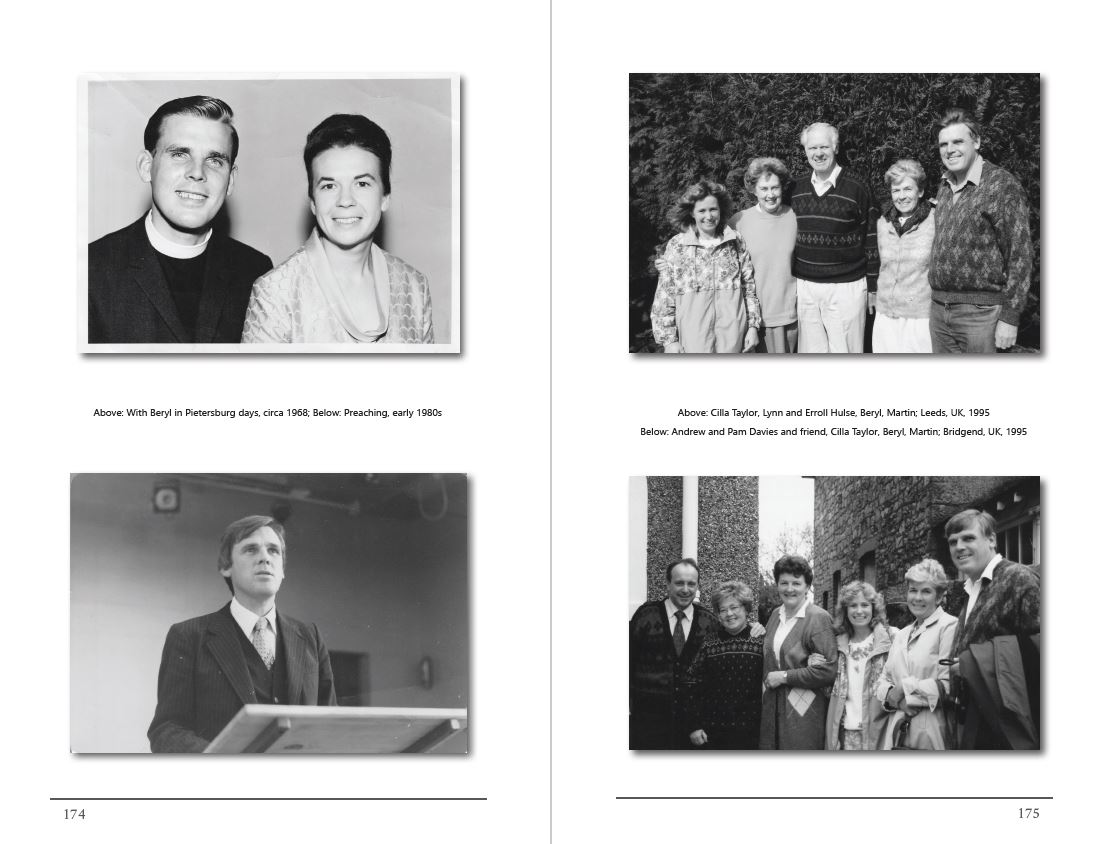
I first met the subject of this mini-biography of Pastor Martin Holdt in 1994 in Atlanta. I was privileged to have him as a friend and confidant for the next sixteen years until his untimely passing. I shall always thank the Lord that I could know such a man of God as Martin Holdt.

Thanks go to Rex Jefferies and Shepherd Press for writing and publishing this inspirational biography of Pastor Holdt.  Its many strengths include the following:

  1. Rex Jefferies was a friend and co-worker of Martin Holdt and knew the subject well.
  2. Rex Jefferies lives and ministers in South Africa and knows the national context well.
  3. Rex Jefferies had access to surviving family members, correspondence and Martin’s many friends and co-laborers for more information. We get a well-rounded picture of the man.
  4. Rex Jefferies is a spiritually minded man and has extracted the best qualities of Martin’s life and ministry to highlight. It is an inspirational read and I stopped and prayed several times in thanksgiving to God for such an example and that I might have more of what moved Martin.

My only complaint is selfish–that there was not more to savor. Martin Holdt knew God personally and intimately and that alone makes a man larger than he would be otherwise. Much more could be written about Martin, his interior life, his theology, the spiritual and cultural context of late 20th and early 21st century South Africa, his weaknesses, etc. But that would have been a much larger biography.

I thank God for this uplifting biography of a much used man of God that serves to whet the appetite for a larger biography to come perhaps. May God uses this book to motivate many to pray that God would pour forth His Spirit on many more men and women to “stand in the gap” in their lifetimes, in their unique situations.

Steve Martin | Retired pastor for 31 years in Atlanta, Georgia, USA | Retired Dean of Students at IRBS THEOLOGICAL SEMINARY in Texas / The review originally appeared HERE.


Posted by Jim Holmes in Family and Friends, Guest Post, Spirituality, Windows on My Work, Writing, 0 comments
Reflections and Recollections of My Mother

Reflections and Recollections of My Mother

Reflections and Recollections of My Mother

My mother, Jean Alison Forbes Holmes, died in the early hours of June 21 after a lengthy decline in her health. She was ninety-four years old. I was unable to attend her funeral in person, due to Covid protocols in the UK, but I was able to share an MP4 video tribute. The text on which I based my presentation is below, and the video may also be viewed here.


Mum, Reflections and Recollections

My mother’s life spanned the greater part of a century—perhaps the most remarkable century in human history as far as innovation and technology was concerned. In 1927, the year of her birth, commercial air travel was almost unknown (that was the year Charles Lindbergh flew solo over the Atlantic ocean), the Model T Ford motor car had only just given way to the Model A, and Joseph Stalin was beginning to take control in Russia. What are my early recollections of Mum?

  1. She was a constant presence
  2. She was a steady reference point
  3. She was an avid communicator
  4. She was an energetic producer
  5. She was a compassionate giver
  6. She was family focused

She was a constant presence

I was born on a farm, and the farm was Mum’s domain. She ran the show. Yes, with Dad’s help over the weekends, but the farm was her operation. So she was always chasing things up (she could be kali!), making things happen, keeping the laborers on their toes to ensure that everything was working as it should. One of my early memories goes like this: there was a shamba, a field, where she had to drive through a gate in our ex-military Jeep. She got out to attend to the gate; I got into the driver’s seat and pressed the accelerator pedal with all my might. She was not pleased by my early instinct to become a motorist. I was just three years old at the time!

She was a steady reference point

That ties in with the first point. Her influence helped me form many of the common-grace values I was to hold to as a child: integrity, honesty, truthfulness, politeness, discipline, and other such qualities. God and the Bible—albeit in a low-key way—were very much a part of her culture and thinking. I lived away from my parents quite a bit as I was growing up. I had two years in a boarding school in the Rift Valley in Kenya, and another four or so years in my teens in Rhodesia living with other friends or family members while I attended day school—a happy alternative to boarding school. But Mum (along with Dad) was a constant reference point. The weekly letters, always updating me on local news, how the dogs and cats were keeping, and what life was like for Dad at work, were always received gladly. And this leads naturally to the next point:

She was an avid communicator

She was always communicating. In the early 1960s, Dad bought her a Baby Hermes typewriter, and she would clatter away on it for hours on end writing and then mailing letters to the four points of the compass. When she upgraded her typewriter, I took over that Hermes and taught myself to type. Later, when computers become commonplace, I helped her set up an email address and she was busy emailing back and forth all through the week just as she had done with her typewriter, notwithstanding failing eyesight.

She was an energetic producer

I have an idea that Mum was very reliant on house servants to do a lot of the mundane work, including cooking and cleaning, but when those colonial days came to an end, she got out some cookbooks and started to catch up all the things she had never learnt. Not only were there the mouth-watering smells that came from the kitchen that made me and the dogs and the cats salivate, but there were other projects going on—knitting during the day while she read a book, sewing and making new clothes, and packaging up gifts and necessities to family members living in other parts of the world. She didn’t make a big deal about these things, but just got on very competently and energetically and did them. It was the same with her garden (she must have had green thumbs)—not just the beautiful flower beds and shrubs that she had, but also the vegetables and fruit she grew—a tribute to her capabilities and diligence in managing the agricultural side of things.

She was a compassionate giver

Mum’s giving came through in many ways. Where she knew of a need that she could meet, she just got on and met it. Her modesty and generosity extended widely in ways like this: she saw some wool she thought would be good for knitting a sweater, so she knitted a sweater and mailed it to me. Or she would press on me (or Sue) some cookies she had made—“Take them; you’ll be hungry later on.” I could provide a lengthy list.

She was family focused

Maybe this draws it all together—she was the constant presence, the steady reference point, the avid communicator, the energetic producer, and the compassionate giver. And in it all, she was family focused. I know she wanted me to speak at her funeral, and if it weren’t for the COVID protocols in place, I would be addressing you in real life, not from a monitor like this. But that’s just the way it has worked out. I plan to visit the UK, God willing, for when we scatter her ashes. I mentioned in one of my points that God and the Bible were very much in her thinking. In recent years, I would often say to her, “Mum, the only hope that we as sinners have before a holy God is that there is a Savior, Jesus Christ, who has lived, died, and risen again on behalf of people like us and who welcomes us as we come to Him in repentance and faith.” She would always nod in agreement. So let me leave with you the words of the first question and answer from the Heidelberg Catechism:

What is your only comfort in life and death?

That I am not my own, but belong with body and soul, both in life and in death, to my faithful Saviour Jesus Christ. He has fully paid for all my sins with his precious blood, and has set me free from all the power of the devil. He also preserves me in such a way that without the will of my heavenly Father not a hair can fall from my head; indeed, all things must work together for my salvation. Therefore, by his Holy Spirit he also assures me of eternal life and makes me heartily willing and ready from now on to live for him.


Posted by Jim Holmes in Family and Friends, Reflections, 0 comments
A Mother Remembered

A Mother Remembered

This slideshow requires JavaScript.

A Mother Remembered

A Guest Post from My Sister, Margaret Jones

Birth and Early Years

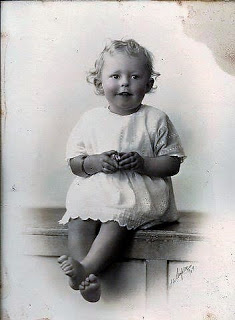
Born Jean Alison Forbes Robb on 29th January 1927 to Gertie and Willlie Robb in Nakuru Hospital, Kenya, she was their only child and arrived rather later in their lives than was common in those days.  She was loved and cherished as a precious gift…though I have no doubt her father would have kept a firm hand of discipline on his headstrong daughter–for headstrong she was.  She was brave and adventurous, riding her horse like a man, completely fearlessly, but with always sensitive hands as she loved animals–probably more than she loved people.  Horseback was probably the most used form of transport she used as a young girl and woman.

The Kenya she grew up in was wild by anyone’s standards.  The roads, such as they were, were largely unpaved murram roads.  The railway from Mombasa through to Uganda was an arterial line and took days through heat shimmering savanna, and through the green softer highlands through the Great Rift Valley, and wheezing and blowing up the Timboroa Escarpment through Eldoret and on to Uganda. I won’t go on because this is about Mum, that’s just background.

Education and Young Adulthood

She was schooled mostly at Nakuru, boarding school as the family lived at Ol Joro Orok.  She was, like the majority of Kenyan children at the time, at boarding school from a very young age.   After leaving school, she worked for a while as a stenographer in Nairobi. I seem to remember she worked for the farming suppliers, Dalgety, Nairobi branch.   In due course she met, fell in love, and married my dad, Reginald Frank Holmes.  Theirs was a long, and as far as I know, a happy marriage.  Mum was feisty and Dad was calm and steady–a good combination.

Farming

Together, they built their rather unusual and adventurous lives. (We didn’t see our lives as adventurous until much later as quite mature adults, then we realised not everyone had enjoyed the freedoms and lifestyle we had.)  The first big venture was Ol Orien Farm, farming in conjunction with my grandparents, her parents.  Dad, meantime, worked mainly with the Soil Conservation Service in Thompson’s Falls.  He did a lot on the farm after work and on weekends, but Mum was the farmer.  It was a mixed farm.  The cash crop was pyrethrum grown for its insecticidal properties.  There was also dairy and maize, and a varying size of poultry flocks…and countless dogs and cats, the odd sheep or two and, of course, the horses.

Other Adventures

After the farm, which was sold just around the same time as Uhuru, independence from Britain, Mum and Dad began their life of living all round the world.  Previous to this, they had travelled a couple of times to Cape Town and back in the short-wheelbase Land Rover  KFT964.  (It was a Series 1, for readers who are interested in such details–and it certainly wasn’t a comfortable vehicle!)

So they lived on the Kenyan coast for a bit, then back in Nakuru.  Then they left Kenya and traveled south, stopping briefly in what was then Rhodesia, now Zimbabwe.  Dad worked for a garage in Bulawayo for a brief period, but he was head hunted by Food and Agricultural Organisation and went to Iraq, which Mum loathed.  I think she found it interesting, but she hated the restrictions on women.  They were only there for a year and then went on to the copper and nickel mine in Selebi Pikwe, Botswana. They were there for a few years and thence to Swaziland, then South Africa, various parts of it,  and eventually stopped at Monteseel almost midway between Durban and Pietermaritzburg.  Dad built them a lovely house there.  Mum made the garden out of virgin bush.  Neither job was unusual for them as they had done this before, starting with their first house together on Ol Orien.

Over the years Mum rode horses less and learned to drive…well enough, but she was a bit erratic at times. But, hey, we are talking a pint-size person who thought nothing of hopping in the current Land Rover, loading it with a handful of dogs, and sometimes cats, too, and traipsing off to who knows where over who knows what kind of condition of road in order to fulfill the current mission, be it visit one of us, or move house, or even just to go on holiday.  So when I say her driving could be erratic, I have to say that the erratic nature was only evident when she hit built up areas and traffic; she was fine driving in the bush and on the open road.

Insights and Thoughts

There was always lots of laughter in our home when we were growing up.  Both my parents could see the funny side in most situations.  I think we learned not to take ourselves too seriously and to avoid being self righteous or stuck up.  The moment we showed any sign of that as kids, we were cut to size and made to laugh at ourselves again.

She brought us up with a fair amount of no-nonsense discipline.  I clearly remember telling some of my little classmates aged about eight, that my Mummy was fiercer than the dreaded Mrs. Holland at our primary school.  I wasn’t wrong either.  You crossed Mum at your own peril.

She was an avid reader and knitter.  She made beautiful clothes for all of us, and no project was too difficult to at least give it a go.  She had the greenest fingers of anyone I have ever known.  She could grow anything and eventually, when she did learn to cook, she was a great cook, too.  She always baked, but in Kenya left the cooking mostly up to the Pishi, Thomas (Cook), or my Granny–Mum was running a farm, remember.

Dementia

So this is what we, her children and to some degree her grandchildren, have inherited from her.  Each of us has put our own interpretation on it, but I think it is thanks to her, and to Dad, that we all have a Can-Do-Will-Do approach to life and we are not afraid to stand up to anyone, no matter how fiercely they present themselves.   She will be missed, but as she recently suffered with quite severe dementia, to be honest, we have missed the real her for some years now.

The last time I saw her, she had just come out of hospital, a frail little shadow of herself.  Nevertheless, when I went to see her she greeted me as if she knew who I was, but what touched me most was that I was with Dave, my son-in-law, and there was no way she knew who he was any more.  Nevertheless all her childhood training and manners rose above the dementia and her own very reduced personal situation and she said to him, “How do you do?  How very nice to meet you again, tell me...how are you?”

That was Mum: the discipline and training to do the right thing in any circumstances right at the fore.  And the rest of us had better not let her down…or else!

Funeral Matters

With regard to her funeral, Mum requested no flowers, please, but if you would like to make a donation to an animal charity of your choice, that would be lovely.  Thank you.

Janet and I would love to see you at the service but realise the difficulty this might present.  My brother, Jim, is recording a tribute to Mum which will be played at the service.  A fellow South African, Raymond Zulu, will be delivering the service, Mum knew him and he is a very warm person.  Shaun will be reading a Scripture text (Mum was a devout Christian).  Geraldine and Alec will be giving tributes.  Afterwards you are invited back for refreshments at Jan’s little house, so please bring an umbrella if the forecast is for rain.


With thanks to my sister, Margaret Jones, for her permission to use her writing with just a few editorial tweaks to help with flow and transition (her original piece, HERE, was written with family members in mind) and with the graphics arranged in a gallery rather than at intervals in the text.


Posted by Jim Holmes, 0 comments
Ninety-Five Theses for a New Reformation

Ninety-Five Theses for a New Reformation

Ninety-Five Theses for a New Reformation

A Guest Post from Professor Donald T. Williams

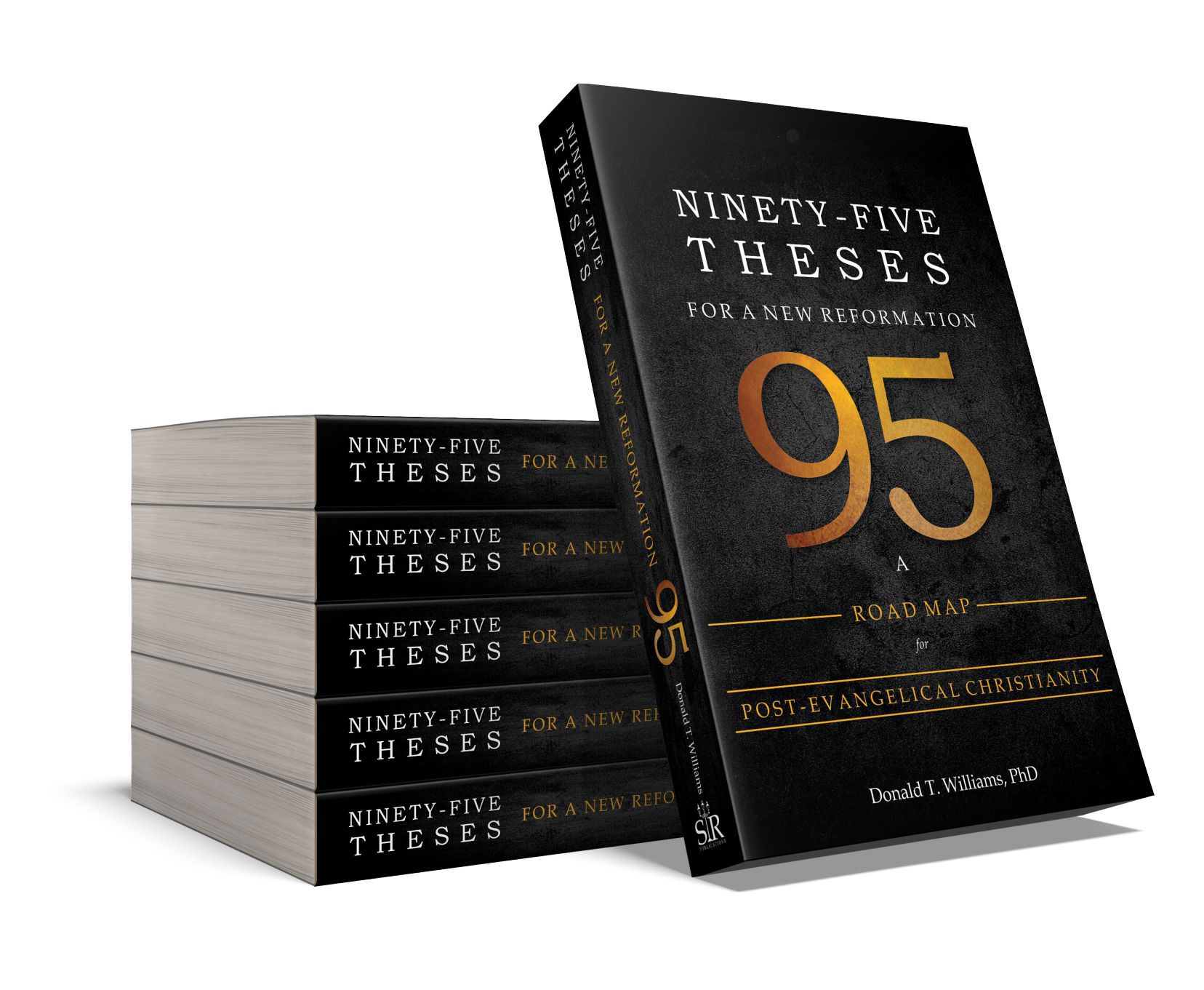
Several months ago, I received an inquiry about how to publish a book. It had a fascinating title: Ninety-Five Theses for a New Reformation–A Road Map for Post-Evangelical Christianity. With its depth and breadth of content, yet it’s surprisingly easy-to-read style (not to mention the author’s own poetic contributions–he is an accomplished poet) I needed little encouragement to help him in the process, and so we set to work to agree a design format and cover to present it with appeal, warmth, and gravitas. Don recently shared news of his book’s release under his own imprint, Semper Reformanda Publications. Here’s what he wrote:


Do you believe the Evangelical movement needs not just a Revival but a new Reformation? Do you think the new book Ninety-Five Theses for a New Reformation (Semper Reformanda Publications, 2021) can be a factor in leading us in that direction?  Here is how you can help!

  1. Get and read the book.
  2. Buy additional copies of it for all your friends and relatives—well, at least for those who might be interested, and particularly for strategic people like your pastor or youth leader who need to be in the vanguard of Reformation.
  3. Donate a copy to your church library, local library. school library.
  4. Write a review for Amazon, publish it also on your Facebook page or other social media, and share it to any relevant Groups you belong to.
  5. Start a Sunday School class or study group where you discuss one Thesis each week (they are all tied to Scripture).
  6. Invite me to speak to your church, school, or other group.  (You can contact me via email at dtw@tfc.edu for that purpose.)
  7. Above all, pray for God’s blessing on the project. Unless the Lord builds the house, we labor in vain. Believe me; I have verified the truth of that verse through much experience!

The church always needs Reformation–perhaps more desperately now than at any time since Martin Luther nailed the original 95 Theses to the Wittenberg church door in 1517. May God use this poor unworthy book to help it happen again! Soli Deo gloria. Amen.

To order, go here.


Thanks to Dr. Donald T. Williams for allowing me to share this content. To find out more about him and his writing ministry, visit his website here.

Posted by Jim Holmes in Current Issues, Guest Post, Heritage, New & Noteworthy, Publishing Books Today, Spirituality, Theology, Windows on My Work, Worldview, Writing, 2 comments
Day by Day, and with Each Passing Moment

Day by Day, and with Each Passing Moment

Day by Day, and with Each Passing Moment

There’s a Hymn on My Radar. . .

The turn of the year provides an excellent opportunity to reflect on how we use the time–the minutes, hours, and days that God gives us–and it brought to mind the words of the hymn by Carolina Sandell (key details are below).

  • Day by day, and with each passing moment
  • Translator: A. L. Skoog;
  • Author: Carolina Sandell (1865) (also known as Lina, and sometimes spoken of as the Fanny Crosby of Sweden)
  • Tune: BLOTT EN DAG | Oscar Ahnfeldt

Enjoy listening to the melody here:

The words are:

1 Day by day and with each passing moment,
Strength I find to meet my trials here;
Trusting in my Father’s wise bestowment,
I’ve no cause for worry or for fear.
He whose heart is kind beyond all measure
Gives unto each day what he deems best–
Lovingly, its part of pain and pleasure,
Mingling toil with peace and rest.

2 Ev’ry day the Lord himself is near me,
With a special mercy for each hour;
All my cares he gladly bears and cheers me,
He whose name is Counselor and Pow’r.
The protection of his child and treasure
Is a charge that on himself he laid:
“As your days, your strength shall be in measure”–
This the pledge to me he made.

3 Help me then in ev’ry tribulation
So to trust your promises, O Lord,
That I lose not faith’s sweet consolation
Offered me within your holy Word.
Help me, Lord, when, toil and trouble meeting,
E’er to take, as from a father’s hand,
One by one, the days, the moments fleeting,
Till I reach the promised land.

For my musically minded readers, you could view the score HERE (thanks to Hymnary.org). And I see that hymnary.org also offers a dynamic / interactive way of viewing the hymn music as it is played HERE. However, be prepared that this seems a much speeded up version!


Further Insights

Hymnary.org (HERE) offers further interesting insights:

Translator: A. L. Skoog

Skoog, Andrew L. (Gunnarskog, Sweden, December 17, 1856 [sic]–October 30, 1934, Minneapolis, Minnesota). Evangelical Covenant. Son of pietists. Tailor’s apprentice at 10. Family emigrated to St. Paul, Minn., when Andrew was 13. Only formal music training was 12 lessons on a melodeon. Organist, choir director, and Sunday School superintendent in Swedish Tabernacle, Minneapolis, 1886-1916. Co-editor of hymnals: Evangelii Basun I & II, 1881-1883; Lilla Basunen, 1890; and Jubelklangen, 1896. Was in editorial committee of Covenant’s first three hymnals: Sions Basun, 1908; De Ungas Sångbok, 1914; and Mission Hymns, 1921. Editor and publisher of Gittit 1892-1908, a monthly choir journal with music; a series of ten bound volumes of choir selectio… Go to person page >

Author: Carolina Sandell

Caroline W. Sandell Berg (b. Froderyd, Sweden, 1832; d. Stockholm, Sweden, 1903), is better known as Lina Sandell, the “Fanny Crosby of Sweden.” “Lina” Wilhelmina Sandell Berg was the daughter of a Lutheran pastor to whom she was very close; she wrote hymns partly to cope with the fact that she witnessed his tragic death by drowning. Many of her 650 hymns were used in the revival services of Carl O. Rosenius, and a number of them gained popularity particularly because of the musical settings written by gospel singer Oskar Ahnfelt. Jenny Lind, the famous Swedish soprano, underwrote the cost of publishing a collection of Ahnfelt’s music, Andeliga Sänger (1850), which consisted mainly of Berg’s hymn texts.


Posted by Jim Holmes in Current Issues, Hymns, Reflections, Spirituality, Technology, 1 comment
Standing at the Portal of Another Year

Standing at the Portal of Another Year

Standing at the Portal of Another Year

I remember first singing the words of this hymn on a New Year’s Eve in Johannesburg in the 1990s. Our congregation sang it to the melody of Like a River Glorious. You could listen to the melody below and track with the words after it:


1. Standing at the portal
Of the opening year,
Words of comfort meet us,
Hushing every fear;
Spoken through the silence
By our Father’s voice,
Tender, strong and faithful,
making us rejoice.

Refrain:
Onward, then, and fear not,
Children of the day;
For His word shall never,
Never pass away.

2. “I, the Lord, am with thee,
Be thou not afraid;
I will help and strengthen,
Be thou not dismayed.
Yea, I will uphold thee
With My own right hand;
Thou art called and chosen
In My sight to stand.” Refrain:

3. For the year before us,
O what rich supplies!
For the poor and needy
Living streams shall rise;
For the sad and sinful
Shall His grace abound;
For the faint and feeble
Perfect strength be found. Refrain:

4. He will never fail us,
He will not forsake;
His eternal covenant
He will never break.
Resting on His promise.
What have we to fear?
God is all-sufficient
For the coming year. Refrain:

Standing At The Portal (For the New Year) Words by Frances R. Havergal, 1873

Music James Mountain (1844-1933)


So, as we stand at the portal of 2021, as we round off the challenging year 2020, here is a reflection on God’s kindness in some of the things He has done. Below is the text of our annual newsletter. You may view the newsletter and its pictures HERE.


“It is more blessed to give than to receive.”

The words above are recorded in Acts 20:35, a quotation by the apostle Paul from Jesus.

God, by his nature, is one who gives. He gave life to our first parents; he gave an environment to them, a perfect one, in which to live. And when they sinned and were ashamed of breaking his law, he provided animal skin coverings for them, an important picture to indicate how he would in future make atonement—covering—for the wrongdoing of them and their descendants.

God gave his Word, the Bible, that we may learn to understand and think aright about him and our world; he gave a system of worship to picture how sacrifice and a Mediator were needed to restore sinners to him in an act of reconciliation.

Ultimately, he gave his Son, Jesus, in a once-for-all act of living on behalf of people, keeping his law perfectly, and dying a death not for his sins—he was sinless—but for the sins of others. The wonderful words of 2 Corinthians 8:9 sum it up: “For ye know the grace of our Lord Jesus Christ, that, though he was rich, yet for your sakes he became poor, that ye through his poverty might be rich.” In being born as a baby boy, God’s purpose was to redeem and reconcile a people to himself who would no longer live for themselves but for him who loved them.
Do you love him and are you living for him who gave himself for people such as we are?


If you’d like a few more pictures, check out the slideshow below:

This slideshow requires JavaScript.

Posted by Jim Holmes in Family and Friends, Hymns, Windows on My Work, Writing, 2 comments