Worldview

What Is More Dangerous Than Covid-19?

What Is More Dangerous Than Covid-19?

What Is More Dangerous Than Covid-19?


A guest post by my friend, Ian McNaughton. Ian is a retired minister in the UK (so he writes with a British perspective), author of several books, and an encourager of the right use of Christian literature wherever there are readers!


To everything there is a season, A time for every purpose under heaven:  A time to be born, and a time to die” (Ecclesiastes 3:1-2a)

As a nation we have fallen away from the Christian foundations fixed in this continent over 2000 years.  It is now a time of social upheaval and spiritual anarchy, fear and bankruptcies; what is to be said?  Spiritual anarchy is a dangerous plague of the 21st century in UK and Europe and it is even more dangerous than Covid-19.  You’d better believe it!

The World Today

God’s laws are being rejected and His holy righteousness is abhorrent to this generation.  The rejection of the Ten Commandments as a rule of life and in politics is a clear example of how far we have transgressed as a western society.  When whole societies rebel against God and truth then there is a waiting for judgment.  Remember the cities of Sodom and Gomorrah?  Remember Pompeii?  God is not mocked.  Remember the Old Testament prophets especially Jeremiah, who preached against the sins of Israel warning of coming chastening?  The outcome of unbelief and anarchy is seen in God’s purifying judgments throughout human history.  Nor are the churches immune from God’s loving discipline (cf. 1 Peter 4:17; Rev. 2: & 3).

Anarchy is the rebellious child’s response to good advice and caring love and it is more dangerous than any earthly plague.  However, God is love and all he does is out of caring and kindly love.

To define love is to define God our Creator and Father in heaven.[1]

‘Who is the Lord?’

There was a plague in ancient Egypt–sound familiar?  However, it took ten plagues from God to break the hardened stubborn heathen heart of Egypt’s despot ruler.  God’s self-revelation in Scripture and in nature is clear for all to behold but our leaders need to listen.  Pharaoh said, ‘Who is the Lord that I should obey his voice?’’ in a retort to Moses the servant of God (Ex. 5:2).  This God, whom Pharaoh disbelieved in, is our God and Savior.  There is a call to the nations during this pandemic; it is a call to repentance. But who will blow that trumpet so it is heard?  The mainline churches and their leaders are running silent.  Until a voice is raised up to broadcast this important point ?we can expect hardened hearts to harden more; unbelieving hearts to blaspheme more; confused and mislead professing Christians to remain unregenerate.

Pray for a Conviction of Sin

Why is it that we ‘Moderns’ think ourselves free from the judgment to come and suppress the fear of God the Almighty?  Christians want the best for all citizens but the gospel churches are mocked.  God’s people want eternal life‘s blessings for their neighbors but they ignored the good news that Jesus has risen from the dead and offers life in all its fullness.  Believers pray for a conviction of sin in the hope of revival of true religion in the soul and throughout the land.  However, the lost are insensible to the fact that to neglect true spirituality, found only in Jesus Christ and his gospel, is to be lost forever.  To deny the reality of God and the free offer of eternal life from God who loves us is to live a lie.  To reject Christ Jesus’ free offer of free salvation found in the gospel is to live without hope.  What more can we say?  I end with a borrowed comment (from a friend) that needs to be heard:

‘Christianity does not offer a remedy for Covid-19.  Christianity offers a remedy for sin, “the blood of Jesus Christ his (God’s) Son cleanseth us from all sin”, (1 John 1:7).  It offers a remedy for death, Jesus said, “I am the resurrection, and the life: he that believeth in me, though he were dead, yet shall he live: And whosoever liveth and believeth in me shall never die” (John 11:25 & 26).  This is Christianity’s unique and glorious message.’[2]

Abide in the Vine

“My Father is the vinedresser.  Every branch in Me that does not bear fruit He takes away; and every branch that bears fruit He prunes, that it may bear more fruit” (John 15:1-2)

This parable is telling us God is looking for holy fruit from our lives. He has blessed us and helped us and kept us and provides and been very patient too. But have we been thankful? Have we worshiped? Have we witnessed? The branches that are barren are pruned to remove or stimulate growth so that fruit is produced. The Gardener does it: God does it. Jesus is the Vine. This is how God works and this is what he is doing during this pandemic.  He prunes, ‘that it may bear more fruit’. History records epidemics, pandemics, disasters, and judgments in the providence of God. Remember the great London plague of 1666 (c.100,000 died). In the Spanish ‘flu’ pandemic of 1918, millions died.

“If anyone does not abide in Me, he is cast out as a branch and is withered; and they gather them and throw them into the fire, and they are burned” (v.6).


© Rev. Ian S. McNaughton

revi@talktalk.net

[1] Let me know if you would like my tract ‘God’s love’.
[2] http://spimomder.blogspot.com/

Posted by Jim Holmes in Current Issues, Friendship, Gospel, Sickness, Worldview, 0 comments
When Life Turns Upside Down

When Life Turns Upside Down

When Life Turns Upside Down

I’ve mentioned my friend, John A. (Jay) Younts once or twice before (you could read the post HERE) and it’s a special delight that he resides not too far away from where I live in the upstate of South Carolina. Jay has contributed extensively to the Shepherd Press blog over many years. He and I share much the same kind of worldview, seeing all of life as belonging to God, and the direct involvement of God in day-to-day events.

With what we are now thinking of as the new normal, the advent of the corona virus, I was in discussion with friends at Shepherd Press about how we might be able to provide a resource that would meaningfully address this situation. Enthusiastically and unhesitatingly, Dr. Tedd Tripp saw the importance of the idea. “Ask Jay,” he guided me. “He could do this.” An email or two later, and Jay had confirmed that he would do it, requesting prayer for the project. And it made good sense for Tedd to contribute the foreword to the book!

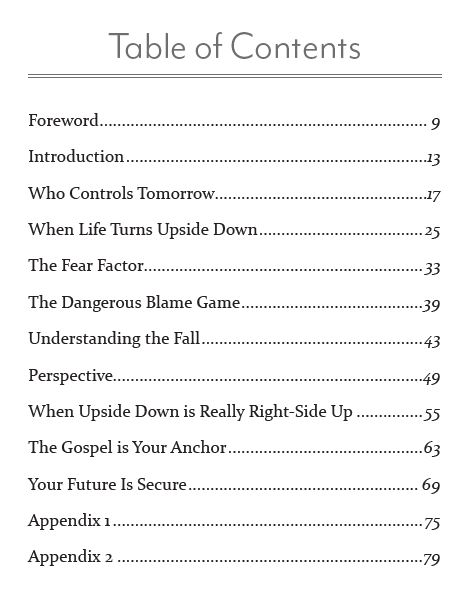
Over the next few days, as he was writing the first draft, we kicked around some prospective titles, soon settling on When Life Turns Upside Down: Finding Stability through God’s Comforting Peace. The table of contents maps out nicely what is in the small book:

Foreword: An Upside-Down World
Introduction: Prayer Keeps Life Right-Side Up
Who Controls Tomorrow: Do Humans Control Tomorrow?
When Life Turns Upside Down: The Power of the Earthquake
The Fear Factor: Fear and Emotional Protection
The Dangerous Blame Game: The Game That Comes Naturally
Understanding the Fall: The Groaning Creation
Perspective: Throughout History, God Remains Faithful to His Promise
When Upside Down is Really Right-Side Up: So There Is Good News!
The Gospel is Your Anchor: The Lord Renews Your Strength
Your Future Is Secure: Death Is Swallowed Up in Victory
Appendix 1: Teach Your Children to Live Right-Side Up
Appendix 2: Comfort for Your Community

It was an interesting exercise figuring out what kind of cover design would work best for the project. Thankfully, there were various people on Facebook who shared what they liked, or did not like, about various proposed cover options!

My view is that this is a vitally important little resource to put in people’s hands. It’s available as an eBook, and coming soon–within a week or so–as a mini-book paperback of 88 pages. It’s easy enough to read in one sitting of under one hour, but also full of biblical content and application to life. Get one for you and your family, and several copies for your neighbors, friends, and work associates. Be sure to check out the Shepherd Press site to find out more about the book and the discounted offers HERE or read some pages from the book HERE.

Endorsements

Over the years, Jay Younts has been my personal Gandalf, my Mr. Miagi, my Paul. With fatherly wisdom and genuine care, Jay offers us this prayerful life-guide, showing us how to live life from God’s perspective and not our own, keeping us right-side up in a world that feels upside down.
Kirk Cameron: Actor, Film Producer

Younts turns our attention to hope found in the mercy of God and the provision he has made for mankind in the sinless life and sacrificial death of his Son, Jesus Christ. This book will provide encouragement and hope in these scary times.
Dr. Tedd Tripp: Author, Pastor, Conference Speaker


About Jay Younts

John A. (Jay) Younts is the author of this book as well as other materials on parenting and the Christian life. He is an experienced blogger, having served Shepherd Press in this capacity for several years. He has been teaching and speaking on current issues for over thirty years. He serves as a ruling elder at Redeemer Associate Reformed Presbyterian Church in Moore, South Carolina. He and his late wife, Ruth, have five adult children.
Follow Jay on Social Media
YouTube Channel: EverydayTalk 24/7
www.everydaytalk247.com
Facebook: https://www.facebook.com/jay.younts
Twitter: @wordsmatter247
jayyounts@gmail.com


Posted by Jim Holmes in Current Issues, Gospel, New & Noteworthy, Publishing Books Today, Windows on My Work, Worldview, Writing, 0 comments
Rudolph W. Giuliani on Leadership

Rudolph W. Giuliani on Leadership

Rudolph W. Giuliani on Leadership

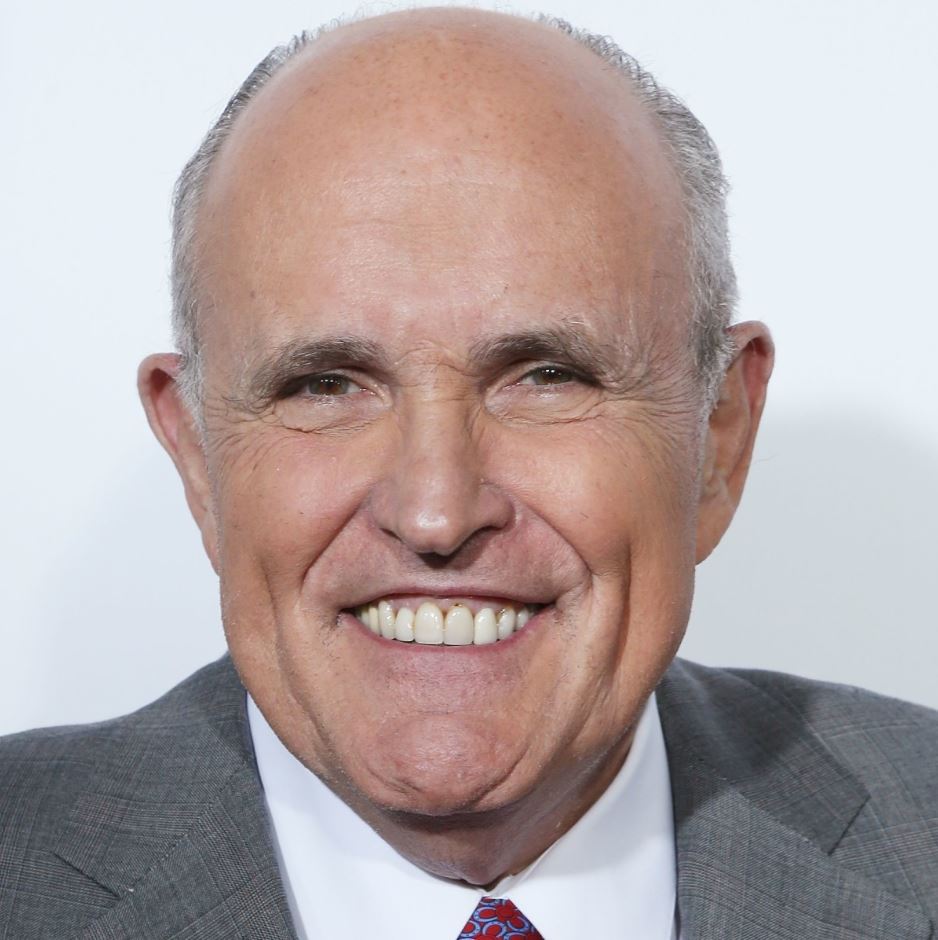
He faced the camera, his poise one of confidence, giving me, a viewer, a sense that he was in charge of the post-9/11 cleanup operation—and what an operation that was. That was my first impression of Mayor Rudy Giuliani of New York City as I watched my TV in Darlington, England. Subsequent views of the same man confirmed my impression that here was a man of competence, a leader, someone inspiring confidence in the stark face of deep trauma, a trauma that was felt by not only New Yorkers, but by people all round the world.

Fast forward nearly two decades: When I saw a secondhand book by Rudolph W. Giuliani in a thrift store in Greenville, I was tempted to buy it, but thought of the many other books at home clamoring for my attention. But I yielded and went back a week later and purchased a copy: Leadership

Written in three parts, the table of contents asserts several propositions about leadership, as below, which the author then engagingly develops in just under 400 pages.

1 September 11, 2001

2 First Things First

3 Prepare Relentlessly

4 Everyone’s Accountable, All of the Time

5 Surround Yourself with Great People

6 Reflect, Then Decide

7 Underpromise and Overdeliver

8 Develop and Communicate Strong Belief

9 Be Your Own Man

10 Loyalty: The Vital Virtue

11 Weddings Discretionary, Funerals Mandatory

12 Stand up to Bullies

13 Study. Read. Learn Independently

14 Organize Around a Purpose

15 Bribe Only Those Who Will Stay Bribed

16 Recovery

Giuliani’s childhood was shaped by strong Roman Catholic values, a love for history, an optimistic sense of what it is possible to achieve in this world, and, at times, being egged on to a good display of streetwise behaviors that helped him in his adult years to face down bullies and crooks.

The author’s can-do spirit breathes optimism through the book. At times, I found myself disagreeing with some of his faith values—I am protestant to the core—but I found myself loving his sincerity and zeal for faith as he knows it, and especially his commitment to a Judeo-Christian worldview and its outworking in the form of faith, family, and a good, solid work ethic—typical of a classical conservative. His treatment of the so-called squeegee men in NY is classic—Charge them for jaywalking, was his take on it. Nobody had thought of that!



At times a little self-congratulatory, Giuliani nevertheless charms the reader with his love for life, his love for doing the right thing, and for being a fighter to this end. And there is much in this book for ordinary people who are striving for excellence even within their own relatively minor circles. There is a feast in the chapter titles alone. I read this book over the course of a few months in bite sizes at occasional times of the month—in waiting rooms, waiting for a kettle to boil, and at other spare moments. The takeaways, for me, are largely in the propositions in the table of contents. There are many action points to be derived from these. I’ve seen too much blithering leadership in my circles—whether church, publishing, or charity work—over the years. Would that many leaders and prospective leaders would take on board some of Giuliani’s ideas and principles!

Featured image from www.biography.com/.image/t_share/MTQyODE5Nzc1NDczNTI2NTU2/rudy-giuliani-gettyimages-470786844_1600jpg.jpg
Posted by Jim Holmes in Current Issues, Reflections, Worldview, 0 comments
Thinking About Ford v Ferrari

Thinking About Ford v Ferrari

Thinking About Ford v Ferrari

I am preparing this blog in consultation with my son, Matthew, aged sixteen years. He and I have prepared the text below, so some of the writing is entirely his. He and I saw the movie Ford v Ferrari late last year, and, because we found it thought provoking, I also took Sue to watch it a few weeks later. The movie is PG-13, largely as there is some fallen-world language.

It’s a sports action drama, a period setting from the early- to mid-1960s, the time I was growing up. It was fun to see how authentic the setting was—the style of cars, dress, décor, etc., though it did provoke discussion as to whether the Coca Cola bottles were quite authentic.

Characters and Plot

Based on the true story of Ford’s efforts to build a car that could rival Europe’s prime car, Ferrari, at the renowned twenty-four-hour, high-speed endurance race, the story line goes something like this:

Carroll Shelby is a former race-car driver who had to quit the sport because of a heart condition. Lee Iacocca, a member of the Ford Motor Company’s board of directors in charge of marketing, is challenged by Henry Ford (Junior) to find a way to appeal to an emerging youth demographic—baby boomers—who are attracted to more attractive, high-speed foreign cars. With Shelby, he thinks he has just the man for the job. Shelby decides to build a Ford car that will have capability to win the Le Mans race, and lobbies to have Ken Miles, an old friend, in the driver’s seat. Miles, a part-time racer, part-time auto-mechanic—a British man living in LA with his wife and son—is a hothead who is unwilling to help until the IRS come knocking. And then the need for finance propels him into the position.

After much corporate resistance, the Ford company reluctantly agrees to let Shelby and Miles apply their own ideas in a way that works, even if it does not conform to conventional company values. This climaxes in several thrillingly shot racing motor-racing sequences (the surround-sound effect in a cinema adds compellingly to the experience).

Well Produced

The movie would be entertaining but nowhere near as compelling if not for the strong character acting from Matt Damon and Christian Bale—and the good direction and cinematography that undergirds the production, courtesy the skills of people such as James Mangold. The witty, clever dialogue is the frosting on the cake, as my son insists!

A Key Quote

“There’s a point, seven thousand RPM, where everything fades. The machine becomes weightless, it just disappears. And all that’s left is a body moving through space and time. Seven thousand RPM, that’s where you meet it. It creeps up near you, and it asks you a question. The only question that really matters. Who are you?”

Thought Provoking

The movie elicited several thoughts:

  • This is a reminder of how the can-do American spirit can propel gifted people to excellence, notwithstanding several circumstantial challenges along the way.
  • Challenging the status quo—that is bucking the system—is sometimes the only way to get something done.
  • Life in this world is often fundamentally not fair! (And that is a profoundly biblical line of thought.) Without giving away anything in the movie, suffice it to say that not everyone is rewarded as he should be!
  • Facts can be as entertaining as fiction; the movie is well rooted in historical fact.

Matthew offered a parting summary: “A movie about American men doing manly, American things in the masculine America of the time.”

View the Trailer HERE: or below

Featured Image Credit: https://www.rottentomatoes.com/m/ford_v_ferrari/pictures

Posted by Jim Holmes in Creativity and Aesthetics, Family and Friends, Reflections, Spirituality, Technology, Worldview, 0 comments
Thinking about Books

Thinking about Books

Thinking about Books

Earlier in the year, I was challenged on Facebook to write notes on books that I have read and enjoyed. Here are some of the notes:

Pilgrim’s Progress

My sister Margaret Jones asked me to share books that I have found significant. So I thought of my copy of The Pilgrim’s Progress and am thankful for being persuaded to purchase the cloth-bound copy as long ago as 1981! Did you know that PP is said to be the second-best-seller to the Bible?


The President, the Pope, and the Prime Minister

Continuing to engage with my sister, Margaret Jones, who asked me to share books I have found significant, I thought this time that I would reference John O’Sullivan’s “The Pope, The President, and the Prime Minister.” While there are some aspects and interpretations in the book I would not agree with, I very much enjoyed the way in which O’Sullivan wrote so engagingly about three figures who had a remarkable influence on the world in the 1980s onward.


Hard Call

As I continue this short journey of reflection on books I have appreciated over the years, as requested by my sister Margaret Jones, a leadership book by the late John McCain comes to mind, “Hard Call.” I first read it about ten or more years ago, perusing the chapters with enjoyment as I was flying from place to place in my sales and marketing job. McCain engagingly teases out lessons of leadership from a wide range of people and events! You can dip into any of the chapters without reference to the others.


A Body of Divinity

Continuing the thought of books that have made a strong impact on me, as requested by Margaret Jones, I am thinking right now of the remarkable writing of Thomas Watson, a puritan minister, who prepared, inter alia, “A Body of Divinity.” It proved to be my first puritan book purchase, and came from The Bible Centre in Pietermaritzburg in 1982.
Watson is incredibly readable. You can find something quote-worthy at random on any page. Here is one:
“The wisdom of God is seen in making the most desperate evils turn to the good of his children. As several poisonable ingredients, wisely tempered by the skill of the artist, make a sovereign medicine, so God makes the most deadly afflictions co-operate for the good of his children. He purifies them, and prepares them for heaven. 2 Cor 4: I7. These hard frosts hasten the spring flowers of glory.”
Pictured is a later edition; I am pleased to own the hard-cover edition with muted red tones!


The Forgotten Spurgeon

As I continue this occasional journey through books that have been seminal in my thinking (at the request of Margaret Jones), today’s reflection is on Iain H. Murray’s “The Forgotten Spurgeon.” I received my copy as a gift from a good friend in the early 1980s but I only read it a few years later. And when I did, it was most helpful, relative to some issues I was working through. In it, Iain Murray provides a brief bio of CHS, the so-called (and well-deserved name) of the prince of preachers, 18th century Charles Haddon Spurgeon. Thereafter, Murray traces three noteworthy issues CHS faced: baptismal regeneration, the free offer of the gospel, and the Downgrade Controversy, a battle he faced with fellow Baptists who were crumpling and crumbling under the effects of modern, liberal, Bible-denying criticism. Spurgeon’s oft-repeated saying, as I recall from memory, “Fellowship with known and vital error is participation in sin,” should be axiomatic in today’s church, but sadly is not so. There is much to learn and apply from this excellent work, and I commend it as the right medicine for many of the issues modern believers are facing.


Surprised by Joy

Continuing the meander through thoughts about books I have enjoyed over the years, as requested by Margaret Jones, the next one that comes to my mind is one by C.S. Lewis. I was a university student at the time, battling my way through a mountain of indiscriminately varied books in an English syllabus–many of them patently boring, others full of filth. Then, in a secondhand store, I came across Lewis’ little gem, “Surprised by Joy.” The title is derived from a Wordsworth sonnet and of course also has peculiar significance to C.S.L. personally. Tracing his early life and influences, the author, with grace and freshness of style, paints beautiful word pictures of the earlier parts of his life, and how even in his rebellion, he found himself finding God and grace. What an oasis this book was to me in the wilderness of everything else I was reading at the time!


Look out for more book reflections as we move into 2020!

Posted by Jim Holmes, 0 comments
Some 2019 Projects in Review

Some 2019 Projects in Review

Some 2019 Projects in Review

The year has been one of steady focus on numerous editing, production, and publishing projects. Here, in no particular order of priority, are some insights into them…and this is by no means an exhaustive list!

Devotional Poems

IMMANUEL: Poems and Meditations on the Life of Jesus: This is the second in a series of Christmas books produced for EvangAlliance Publications, an 80 page full color cloth-bound book (with loose dust jacket), with beautiful poems and is truly a magnificent production. It is a companion to a book we worked on last year, INCARNATION Poems, also by poet Tom Worth. See more HERE.


The One Anothers of the New Testament

31 Ways to be a One Another Christian An email from Dr. Stuart Scott initiated this one. He and Andrew Jin had been working on a script that teased out the implications of what the New Testament has to say about “one another.” Would Shepherd Press be interested, he asked? Of course! The year was well progressed, and an ACBC deadline for launching the book was approaching with uncomfortable rapidity, so we accelerated the editing and production and were able to launch this excellent book in October. More info HERE.


365 Plus…

Daily Readings books have a special place in my heart. There are two that have been under my purview this year, both relatively late in the year.

The first is a compilation of the wonderful My Coffee Cup Meditations books by Roger Ellsworth and family. The more I thought about it, the more I wanted to get all twelve of these volumes into one big book. And the name that came to mind was simply The Big Book of Coffee Cup Meditations. It is truly a magnificent book, cloth-bound, nearly 800 pages in length. Roger writes on the back cover as follows:

Early mornings are very predictable for lots and lots of Christians. Roll out of bed, turn on the coffee pot, pour a cup, settle into a favorite chair and enjoy what is called “the daily devotional.” This usually consists of reading a passage from the Bible and a selection from a daily readings book. It concludes with prayer.

Believers who follow this pattern can go through a good number of devotional readings as the years go by. So they are always looking for new material—something to go along with their Bible and their coffee.

Hoping that I could be helpful in supplying the need for more of these kinds of readings, I gathered up some articles I had written and put them in a book—A Dog and a Clock. The idea was to supply brothers and sisters in Christ with enough devotions to carry them through one month. That quickly led to another book—The Thumbs Up Man—to carry “devotion-doers” through another month—and so on.

You can guess what happened after three or four books came out. There are twelve months in the year. So why not provide enough books to cover a year? Well, off we went and out the books came until there were finally twelve! Since these books were designed to go with the Bible and a good cup of coffee, it seemed right to call them My Coffee-Cup Meditations. Here are all twelve books in one big volume—372 readings in total!

More information HERE.

A good friend and former colleague connected me with new friends in TMAI–The Masters Academy International–in California who were in the final stages of preparing a large devotional book with multiple authors for publication. Would I help guide it through the process? The timing was tight, but the outcome is a beautiful (nearly 400 page) book, Declaring His Glory among the Nations. An edition of this book is available on Amazon HERE.


Esther: For Such a Time as This

Colin Mercer labored faithfully in Greenville, SC, for about a decade. I got to know him and appreciate his preaching at Faith Free Presbyterian Church. Friends there, Charles and Verta Koelsch, worked tirelessly on Colin’s sermon notes to prepare a very useful book on God’s care and providence as seen in the Old Testament book of Esther–with the title For Such a Time as This: The Sovereignty and Goodness of God in the Book of Esther. The outcome is a beautifully produced book of 176 pages. An edition of this book is available on Amazon HERE.


Tennessee Author Friends

Reggie Weems is a good friend in ministry in Eastern Tennessee, and we just released an excellent introduction to C.S. Lewis. In his series of “Ten Things About…”, the new The Man Who Made Narnia is a welcome addition to a man whose influence is truly remarkable. Also in preparation for 2020 is Good, But not Safe. The first title is available on Amazon HERE.

Dave Harrell, also a pastor in Tennessee, wrote a very good book on pastoral leadership. It was my pleasure to guide this through the editing and publishing process at Shepherd Press early in 2019. Soon after this was complete, Dave reached out to me with the thought of how his ministry, Shepherds Fire, could publish mini-books. After conferring on some strategic options, we came up with the idea of “The Compact Expository Pulpit Commentary Series,” small books of around 88 pages, each one packing a powerful punch in terms of both content and application. You can read more about Dave and his ministry HERE and obtain his books on Amazon as follows:

  • God, Evil, and Suffering HERE
  • God’s Gracious Gift of Assurance HERE
  • Our Sin and the Savior HERE


South African Connections

Dr. Francois Carr is based in Pretoria, South Africa, and has a global ministry in calling people to Christ and a consecrated walk with Him. One of his earlier books, Lead Your Family in Worship, had gone out of print. Francois reached out to me with the question: How could this book be brought back into print? Well, we found a way! We did a couple of prototype runs and the book has a few tweaks to go, and we expect to launch the agreed final version early in 2020. 

“It is an old but good saying that families which pray together stay together. This refreshingly up-to-date book on family worship is a valuable contribution to a much-neglected area of Christian practice. May God be pleased to bless its teaching to many.”–Rev. Maurice Roberts: Minister, Free Church of Scotland Continuing, Inverness, Scotland

The contents for Francois’ book are good for whetting the appetite:

Introduction
1: A Forgotten Command of God
2: Why is Family Worship Necessary? (A)
3: Why is Family Worship Necessary? (B)
4: Why Don’t Families Worship Together Anymore?
5: Common Excuses for Not Having Family Worship
6: How Do I Prepare Myself and My Family for Worship?
7: How Do We Worship as a Family?
8: What are the Foundations of Family Worship?
9: A Final Encouragement
Appendix 1: Where Do I Start?
Appendix 2: Suggested Format for Family Worship
Appendix 3: Suggesed Format for Family Worship
Appendix 4: An Example of Family Worship

The Man in the Gap Martin Holdt was my pastor for many years in South Africa. A good and godly man, the story of his life is more than worthy of being told. Friends Rex and Esta Jefferies in South Africa have labored hard to prepare a biography, and they and I have been exchanging files for a couple of years or more to get the text prepared for publication. We anticipate launching this book in the first quarter of 2020. Dr. Joel Beeke in the Foreword describes this as a “must-read” book!
Here are three fragments from Dr. Beeke’s  Foreword

I love good biographies of godly men. They are so stimulating, convicting, edifying, moving, challenging, and alluring. This is one of those biographies. It is a “must read” book—one that is so true to a godly pastor who lived, by God’s grace, wholly for Christ and out of love for the souls of people.

Martin Holdt was one of the very best friends in Christ Jesus that I have ever had. He was also one of the most godly people I have ever known. When he died so suddenly in the last week of 2011, I grieved as if I had lost a brother—because I did. He was like an older brother to me.

Read this book prayerfully, meditatively, and slowly. I pray God that Martin Holdt’s life story will move you to follow him insofar as he followed Christ.

Posted by Jim Holmes, 0 comments
The Writing Apologetic Ministry of Edgar Andrews

The Writing Apologetic Ministry of Edgar Andrews

The Writing Apologetic* Ministry of Edgar Andrews

*Apologetic: Here meaning having to do with the defense of, or reason for, the faith that one holds.

I first met Professor Edgar Andrews in 1999. I recall him, distinguished, articulate, erudite—in many ways, just what you might expect a professor to be. At the time, he was chairman of Evangelical Times and Evangelical Press. I had just relocated to England and was finding my feet in a new climate, adjusting to a new work situation, meeting new friends, discovering the joys of navigating around English traffic roundabouts (“Who gives way to whom, or do you just pray and take a chance?”) and experiencing many other new things. Our pathways would cross at occasional board meetings and when he would come to the Faverdale office in Darlington to oversee the production of the monthly paper.

We enjoyed good interactions whenever we met. I knew Prof. Andrews was much more than a brain on legs, but I always felt somewhat in awe of his great intellect—a man who knew so much about the science of materials, and yet who was at home with English literature, history, theology, ancient Greek, and many other disciplines.

I had first known of him through various of his writings, and in South Africa had enjoyed selling his books in several of my sales initiatives through Reformation Heritage Trust, subsequently renamed Barnabas Book Room. Always solid in their content, always clearly written, always with modern application, his books resonated with me and with the reading clientele Sue and I served…

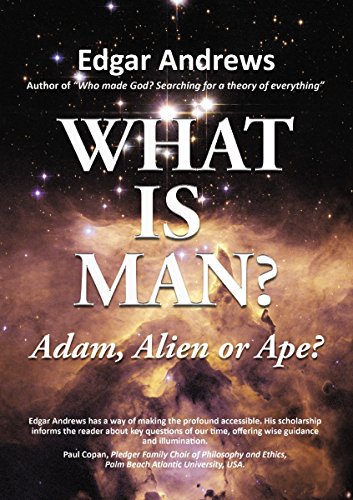
So when Edgar contacted me again some years after I moved to the USA, I was delighted to have the opportunity of working with him again on some new projects. One of his earlier publications, Who Made God?, had captured the imagination of the reading public, selling tens of thousands of copies. “I’ve been working on a new book, one on the origin of man, titled What is Man—Adam, Alien or Ape?—do you think you could help promote it?” Edgar asked me. His explanatory email was predictably through in his description of the text and his plans for promoting it internationally. Of course, I was delighted to do so, and once it was in print, it was my pleasure to review it in these words—which you may read on Amazon HERE. (It’s a very good book—as I think you will see from my review notes.)

My Amazon Review Notes

A sequel to his bestselling book, “Who Made God?”, Edgar Andrews’ book “What is Man?” is a carefully thought-through, well prepared, wittily and engagingly written piece.

The author’s background in both arts and science (he is a well-rounded intellectual) eminently qualifies him to write both at length and in depth in areas of science, philosophy, literature, art, and the Christian faith—the latter from a well-informed perspective of faith. He engages robustly with some important minds along the way.

While Professor Andrews might be described as a “brain on legs,” he is a very capable communicator, taking complex concepts and subjects, breaking them down into bite-sized examples, making judicious use of illustrations to simplify them (yet without being simplistic) and then drawing lines of application to modern life and especially in challenging the thinking of people who may have mistakenly and uncritically imbibed the presuppositions and worldview of a generation who have more often been informed by talk-shows and TV than by well-reasoned scientific disciplines and carefully considered theological and philosophical conclusions.

To sketch the book by way of overview, Professor Andrews takes readers, as it were, by the hand (never condescendingly) and guides them page by page, step by step, idea by idea, through a maze of considerations considered within three categories: Man and the Cosmos, Man and the Biosphere, and Man and the Bible.

Under the first part, (Man and the Cosmos) the author gives consideration to key concerns such as the identity of humankind, the impossibility of the universe being self-creating, the willful conjecture of the media in inventing and embellishing highly detailed “facts” when there is no undergirding evidence, the habitability of the world (what he refers to as a fine-tuned universe) and the difficulties posed by the conceptualization of a multiverse.

Part 2 (Man and the Biosphere) considers people as unique creatures, traces the ramifications of the complexity of genetic mapping, spends some time on speculations that have arisen in light of fossil research and dating, and rounds off with some philosophical and ontological sketches with respect to human consciousness.

The third part of “What is Man?” (Man and the Bible) begins to draw many of the ideas heretofore explored into a unified conclusion, and provides a probing analysis of worldviews, the historicity of the fall of our first parents, the imago dei, Christ as the Second Adam, and the undeniability of the resurrection of Jesus.

Is this a “preaching, condescending kind of book”? I didn’t find it so. The author’s calm writing style, his eloquence, his gentle wit—these are all engaging features. In it all, I felt he was letting his readers come to their own conclusions at their own speed. Truth is compelling. Truth has the power, under God, to be life-transforming. This is the kind of book most people will easily be able to read. Be sure you are one of them and get one—and an extra one or two, too, for a family member or work colleague whom you might like to challenge to rethink some aspects of life!

Other Writings of Professor Edgar Andrews

I have worked with Edgar in lightly editing, reformatting, and republishing his most helpful book on Galatians (EP Books used to have it in the Welwyn Commentary Series—though Great Writing Publications it is titled Free in Christ—The Message of Galatians for Today) (more about that in another blog entry another time) and it’s on my radar soon to have his excellent commentary on Hebrews—A Glorious High Throne—back in print, also in the Great Writing Publications imprint.
 

Posted by Jim Holmes in Biblical Creationism, Current Issues, Gospel, New & Noteworthy, Publishing Books Today, Worldview, Writing, 0 comments
Everything Says, “GLORY!” (Jim Albright)

Everything Says, “GLORY!” (Jim Albright)

Everything Says, “GLORY!” (Jim Albright)

Our pathways crossed some years ago when I was introduced to Jim Albright and helped him get his first book into print. We kept in contact, and some months ago, he reached out to me and mentioned he was ready to do his second book–and would I help him to do so? Well, the pleasure was all mine!

In the book, Jim Albright really does a great job to undermine and demolish some of the axiomatic beliefs of evolution. And what is so useful about it is that he uses many “insider” quotes from the evolutionists themselves in pointing out the weaknesses and inconsistencies of their assumptions and conclusions. As the blurb on the back cover of the book puts it,

In seven articulately written chapters, Jim Albright persuasively pinpoints and exposes the pseudo-scientific tenets of macro-evolutionary thinking. Replete with quotations from scientists across many disciplines, this is a book that every Christian should own. Missionary Keith Jones is right, “The best part of this book is that it will provoke you to a whole new level of worship!”

The book comes with several compelling endorsements, such as

  • “. . . a staggering number of relevant (often shocking) quotations from scientists and researchers.”—Professor Don Whitney
  • “Albright makes the case in a way that causes you to say, ‘How could it be possible to believe in evolution?’”—Pastor Jim Elliff
  • “. . . utilizes scientific and logical evidence to expose the lie that evolution is.”—Professor Jim Ehrhard
  • “My advice, dear reader, . . . sincerely contemplate what you find in these pages.”—Pastor Lance Quinn
  • “. . . your tongue and heart are loosed to speak what you know is true with confidence and assurance.”—Missionary Alan Johnston
  • “A great resource for the church . . . a layman’s synopsis.”—Pastor Brad Vaden
  • “. . . a treasure of quotable science.”—Pastor Dow Welsh
  • “Read this book closely; think deeply; observe inquisitively; worship passionately.”—Pastor Doug Richey
  • “The best part of this book is that it will provoke you to a whole new level of worship.”—Missionary Keith Jones

Peacock and Poppycock

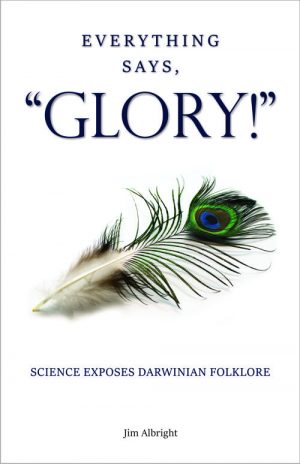
My colonial and English background make me rather like the word “poppycock.” Jim uses it to good effect in some descriptive text. There is a peacock motif that runs through the book. That was really why the cover was so important to “get right.” Below is the text from some early matter in the book:


About the Cover

So, why the peacock feather on the cover? Because Charles Darwin hated it. He wrote, “The sight of a feather in a peacock’s tail, whenever I gaze at it, makes me sick!”[i]

The obvious problem was that he did not know how to plausibly explain this large, mathematically patterned, jewel-colored, gratuitous display of beauty in evolutionary terms. A peacock tail can stand five feet high. And all those cumbersome feathers are most inconvenient regarding the chief survival-of-the-fittest issue—namely, not being eaten. This was no small dilemma for Mr. Darwin.

In keeping with his general approach to science, Darwin concocted a story. Give the man credit. He knew how to weave a narrative. This is, of course, the foremost skill of his disciples. Storytelling is far less bothersome than engaging in the exacting rigors of real science.

Darwin proposed a theory of sexual selection. That is, peahens prefer peacocks with the best tails. Best meaning, the biggest and most colorful. The gaudier the tail, Darwin surmised, the better the peacock would fare with the peahens, and consequently pass on more of the flamboyant plumage genes to male offspring.

Oops. Yeah, this doesn’t actually happen. This is where storytelling, as opposed to truly doing science, puts one in a bit of a bind. A “seven-year study that observed 268 matings”[ii] conducted by scientists seeking to confirm Darwin’s theory, found that peacock sexual selection based upon the coolest tail, is, and sorry, I couldn’t resist borrowing Ph.D. David Catchpoole’s quote, “poppycock.”[iii]

The “tail tale”[iv] is the perfect parable of Darwinian evolutionary theory. It’s all just unsubstantiated anecdotes. Regarding the macro-Darwinian hypothesis, there is no hard data. Zero. But oh, what a fanciful myth of unparalleled imagination has been fabricated for the incurious and unwary!

Darwin hated the peacock feather. It makes no evolutionary sense. Exactly!

[i] Charles Darwin and Francis Darwin, The Life and Letters of Charles Darwin, including an Autobiographical Chapter, Vol. 2 (New York: D. Appleton, 1911), 90-91.

[ii] Catchpoole, D., Peacock tail tale failure, creation.com/tale, 2008. (Creation 31(2):56–Jun 2008).

[iii] Catchpoole, D., https://creation.com/peacock-poppycock (Creation 29(2):56 – Mar 2007).

[iv] Ibid.


Read more about the book HERE.

Purchase the book on Amazon.com HERE

Purchase the book on Amazon.co.uk HERE.


Jim Albright: At the age of 42, Jim left a twenty-year business career to answer God’s call to preach. Since early 2004, he and his wife, Karen, have lived in Milan, Italy, where Jim is the pastor of the International Church of Milan, a non-denominational, Bible-believing, and Bible-teaching church ministering to internationals from around the globe.

Posted by Jim Holmes in Biblical Creationism, Current Issues, Gospel, New & Noteworthy, Publishing Books Today, Worldview, Writing, 0 comments
Favorites 4: Innovation and Endeavor

Favorites 4: Innovation and Endeavor

View Planet Earth from the Orbiting International Space Station

ISS_Tracker_Screenshot

Tracker map detail. Click to enlarge.

This has to be one of the most fascinating sites you can visit. I like to view two sites simultaneously (or, rather, to toggle between them):

What is really neat about the second link is that you can zoom the view and also get a map or hybrid view. And you can observe the velocity and altitude (in miles!) of the craft!

Psalm 111:2 “The works of the Lord are great, sought out of all them that have pleasure therein.”

Psalm 24:1,2 “The earth is the LORD’s, and the fulness thereof; the world, and they that dwell therein.For he hath founded it upon the seas, and established it upon the floods.”

Video clip below, screen capture for 20 seconds, ISS south of Australia, 20180920


The Car That Can Fly

Maverick_Steve_Saint

Maverick in flight

This is about Steve Saint, son of Nate Saint (remember the account of Jim Elliot, murdered in the early 1950s, by the Auca Indians in Ecuador?). View the YouTube video below of Steve’s invention.

(Jim Elliot famously said, “He is no fool who gives up what he cannot keep to gain what he cannot lose.”)

This is a fine example of endeavor driven by a real and practical need on the one hand, and a zest to bring the message of God’s love and grace, in practical terms, to people out of normal and easy reach.

Come to think of it, to buy a flying car for a price ticket of around $80,000 sounds quite good!


Posted by Jim Holmes in Current Issues, Gospel, Heritage, Technology, Worldview, 0 comments
Favorites 2: Devotion and Discipline

Favorites 2: Devotion and Discipline

Noteworthy and Quoteworthy

“He is no fool who gives up what he cannot keep to gain what he cannot lose.
Jim Elliot, Martyred missionary to the Auca Indians

“A wise man will make more opportunities than he finds.”
? Francis Bacon, The Essays

“Many of life’s failures are people who did not realize how close they were to success when they gave up.”
? Thomas A. Edison

“Never give in. Never give in. Never, never, never, never—in nothing, great or small, large or petty—never give in, except to convictions of honour and good sense. Never yield to force. Never yield to the apparently overwhelming might of the enemy.”
? Winston Churchill, Never Give In!: The Best of Winston Churchill’s Speeches

“Courage is not having the strength to go on; it is going on when you don’t have the strength.”
? Theodore Roosevelt

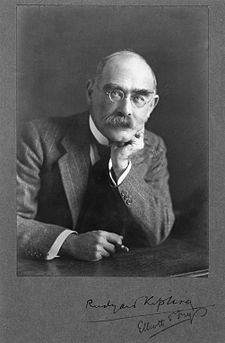
Rudyard Kipling
Asking Questions

“I keep six honest serving men:
They taught me all I knew:
Their names are What and Why and When
and How and Where and Who.

Rudyard Kipling (Image credit: Wikipedia)

airplane-takes-off-into-wind
bird-roundelSaid the Robin to the Sparrow

Said the robin to the sparrow,
“I should really like to know,
Why these anxious human beings
Rush about and worry so.”
Said the sparrow to the robin,
“Friend I think that it must be,
That they have no Heavenly Father,
Such as cares for you and me.”

Posted by Jim Holmes in Heritage, Humor, Reflections, Worldview, 0 comments