
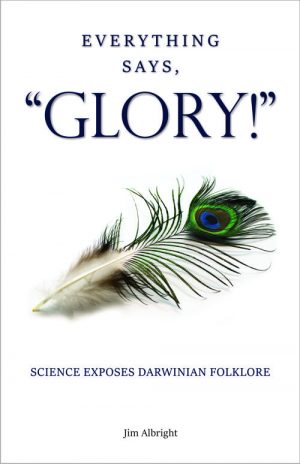
Everything Says, “GLORY!” (Jim Albright)
Our pathways crossed some years ago when I was introduced to Jim Albright and helped him get his first book into print. We kept in contact, and some months ago, he reached out to me and mentioned he was ready to do his second book–and would I help him to do so? Well, the pleasure was all mine!
In the book, Jim Albright really does a great job to undermine and demolish some of the axiomatic beliefs of evolution. And what is so useful about it is that he uses many “insider” quotes from the evolutionists themselves in pointing out the weaknesses and inconsistencies of their assumptions and conclusions. As the blurb on the back cover of the book puts it,
In seven articulately written chapters, Jim Albright persuasively pinpoints and exposes the pseudo-scientific tenets of macro-evolutionary thinking. Replete with quotations from scientists across many disciplines, this is a book that every Christian should own. Missionary Keith Jones is right, “The best part of this book is that it will provoke you to a whole new level of worship!”
The book comes with several compelling endorsements, such as
- “. . . a staggering number of relevant (often shocking) quotations from scientists and researchers.”—Professor Don Whitney
- “Albright makes the case in a way that causes you to say, ‘How could it be possible to believe in evolution?’”—Pastor Jim Elliff
- “. . . utilizes scientific and logical evidence to expose the lie that evolution is.”—Professor Jim Ehrhard
- “My advice, dear reader, . . . sincerely contemplate what you find in these pages.”—Pastor Lance Quinn
- “. . . your tongue and heart are loosed to speak what you know is true with confidence and assurance.”—Missionary Alan Johnston
- “A great resource for the church . . . a layman’s synopsis.”—Pastor Brad Vaden
- “. . . a treasure of quotable science.”—Pastor Dow Welsh
- “Read this book closely; think deeply; observe inquisitively; worship passionately.”—Pastor Doug Richey
- “The best part of this book is that it will provoke you to a whole new level of worship.”—Missionary Keith Jones
Peacock and Poppycock

My colonial and English background make me rather like the word “poppycock.” Jim uses it to good effect in some descriptive text. There is a peacock motif that runs through the book. That was really why the cover was so important to “get right.” Below is the text from some early matter in the book:
About the Cover
So, why the peacock feather on the cover? Because Charles Darwin hated it. He wrote, “The sight of a feather in a peacock’s tail, whenever I gaze at it, makes me sick!”[i]
The obvious problem was that he did not know how to plausibly explain this large, mathematically patterned, jewel-colored, gratuitous display of beauty in evolutionary terms. A peacock tail can stand five feet high. And all those cumbersome feathers are most inconvenient regarding the chief survival-of-the-fittest issue—namely, not being eaten. This was no small dilemma for Mr. Darwin.
In keeping with his general approach to science, Darwin concocted a story. Give the man credit. He knew how to weave a narrative. This is, of course, the foremost skill of his disciples. Storytelling is far less bothersome than engaging in the exacting rigors of real science.
Darwin proposed a theory of sexual selection. That is, peahens prefer peacocks with the best tails. Best meaning, the biggest and most colorful. The gaudier the tail, Darwin surmised, the better the peacock would fare with the peahens, and consequently pass on more of the flamboyant plumage genes to male offspring.
Oops. Yeah, this doesn’t actually happen. This is where storytelling, as opposed to truly doing science, puts one in a bit of a bind. A “seven-year study that observed 268 matings”[ii] conducted by scientists seeking to confirm Darwin’s theory, found that peacock sexual selection based upon the coolest tail, is, and sorry, I couldn’t resist borrowing Ph.D. David Catchpoole’s quote, “poppycock.”[iii]
The “tail tale”[iv] is the perfect parable of Darwinian evolutionary theory. It’s all just unsubstantiated anecdotes. Regarding the macro-Darwinian hypothesis, there is no hard data. Zero. But oh, what a fanciful myth of unparalleled imagination has been fabricated for the incurious and unwary!
Darwin hated the peacock feather. It makes no evolutionary sense. Exactly!
[i] Charles Darwin and Francis Darwin, The Life and Letters of Charles Darwin, including an Autobiographical Chapter, Vol. 2 (New York: D. Appleton, 1911), 90-91.
[ii] Catchpoole, D., Peacock tail tale failure, creation.com/tale, 2008. (Creation 31(2):56–Jun 2008).
[iii] Catchpoole, D., https://creation.com/peacock-poppycock (Creation 29(2):56 – Mar 2007).
[iv] Ibid.
Read more about the book HERE.
Purchase the book on Amazon.com HERE
Purchase the book on Amazon.co.uk HERE.
Jim Albright: At the age of 42, Jim left a twenty-year business career to answer God’s call to preach. Since early 2004, he and his wife, Karen, have lived in Milan, Italy, where Jim is the pastor of the International Church of Milan, a non-denominational, Bible-believing, and Bible-teaching church ministering to internationals from around the globe.





 The cover design of the book caught my eye as well as the title. “Who Moved My Cheese?” it asked. It was a slender volume, no more than 96 pages as I recall, and it told the story of a number of mice that had to face change in life. The longstanding supply of cheese from which they have helped themselves is no more. “What is to be done in securing more cheese?” is the challenge facing these four mice. Written as a parable that takes place in a maze, the story engagingly describes Sniff and Scurry, and their associates, Hem and Haw, and how they go about finding more cheese. Spencer Johnson’s intention is to introduce readers to the concept of positive change and how to cope with it. The book makes for engaging reading.
 The “Big A” has changed a lot of things. At one time, nobody took Amazon too seriously, but not so anymore. Amazon’s ability to operate on a relatively low overhead and to have negotiated specially preferential, volume-related relationships with shippers has dealt the death knell to many vendors who had maybe become comfortable with the status quo. The reality is that people’s buying habits have changed and continue to do so. Most people today are quite relaxed in making online purchases.



 Working in publishing significantly connected me with some fairly well-known authors, including people like John Blanchard, John MacArthur, Andy McIntosh, Roger Ellsworth and many others (you could see a part list
  Making a Plan
 As good J C Ryle said, “The best way to do something is to do it.” So I decided that the best way to start was by pushing ahead in some projects, feeling my way forward using social media and making myself as useful as I was able to. Principles lead to empiricals. “Just try doing it,” I counseled myself. One of the concerns driving me was to establish fair competency in website building and development, so while working on some editing projects for P&R Publishing, I also forayed into the world of Google-Sites and WordPress, soon finding the latter to be quite powerful, and that even eCommerce was not as complex as it might first seem. With thanks, under God, for free online tutorials and perusing numerous FAQs, it was not long before I found my way forward in developing websites for other people to help them promote their writing ministries. These include
  An email that dropped into my in box from an online form submission from one of my websites was very interesting, and even more so when I phoned the man from whom it originated. “I represent a publishing family,” he said, “And in doing due diligence, we wish to establish whether you might be the right person to help in their publishing ministry.” It was an extra surprise, a pleasant one, too, to learn that the publishing family was none other than that of Tedd and Margy Tripp. Tedd (pictured here) is well known for his remarkable book Shepherding a Child’s Heart, a manuscript derived from a doctoral thesis that nobody wanted to publish when he first wrote it, so it ended up being self published (under the quickly thought-up name of Shepherd Press). Now with a sales history of well in excess of a million copies, it is a book that has challenged, blessed, and guided countless parents and teachers over the years. To cut a long story short, following a weekend visit to northern Pennsylvania, there commenced a relationship between me and Shepherd Press that enables me to be of service in the promotion and development of the ministry, and to help in recruiting new authors and rolling out of new resources. That’s just one of the various things that I love doing. You can find out more about Shepherd Press
  Because the Shepherd Press work is flexible and part-time, there are many other things that I do in publishing. Like when Simon Robinson, my good friend in England, told me that he had been writing some notes all about anxiety. “I think we should make a book of it,” I ventured. “If you could get to 31 readings, it could even become a daily reading book.” Simon warmed to the idea immediately and soon after we were exchanging emails and sharing ideas. The outcome not long afterwards was a book in a black and red cover with an anxious man regarding people holding the book—the man on the cover that is—with 31 easy-to-read chapters, complete with Bible reference, application points, and a suggested prayer to pray—even if just to prime the pump, as it were–all to strategically help readers get over the worry factor.
 Jim Dearmore was a Texan in Africa. His story was remarkable for its adventure and spiritual verve. He and his wife, Georgia, had been missionaries in the Congo and then moved to what was then Rhodesia before ending up in the northern regions of South Africa, where they continued their missionary endeavors. His outspokenness against Marxist doctrine made him the kind of person who probably would not be welcome to stay in the country once an ANC government was established. He was one of my favorite customers, a godly man, a no-nonsense American in whom there was no guile. I loved the way his gas-guzzling 1970s automobile drove into the parking lot, so much like a great ship, taking as it seemed several minutes to come to a halt as it berthed. From deep within its recesses (it may have been a Cadillac; it was huge) he would emerge, his short white beard outlined against the greenery in the background. His eyes were kindly, always twinkling. His voice deep and his drawl slow and pronounced, he always spoke wisely and well, often punctuating his speech with apt quotations from the Bible, always in the King James version.
 I loved his straightforwardness, his directness, his call-a-spade-a-spade mentality. He was no stranger to hardship and to hard work. One day he told me about his A B Dick, a printing press he housed in his garage. With relocation back to the USA in mind, he needed to sell it, and he considered that I should buy it. At the time, I was running the book business I had started, and it involved quite a lot of printing that I usually got done in a copy center in Johannesburg. I was also editing a magazine at the time, Reformation Africa South, so that put me in connection with a commercial printer, Leonard Venter. Len was another character. Everything he described was “fantastic.” I mentioned Dr. Dearmore’s offer to sell his A B Dick press to me. In his Germiston accent he enthusiastically said to me, “Fantastic! Jim, my boet, let’s go check out the doctor’s printing press.” A few days later, riding along in his Toyota Camry at around 100mph, we made the long journey north of Pretoria to Dr. Dearmore’s location in a very short space of time.
 The deal agreed some weeks later, we knew we would need space to house it, so a few months later, we commenced building a double garage on our Strubens Valley property. Getting the press from where Dr. Dearmore had housed it to our location was challenging; it weighed more than a ton. And it arrived with a bewildering number of rollers and peripheral items, all with special names and functions that would need to be learned!
 One of the many things I get to enjoy is working with gifted authors.

 I’ve written elsewhere about it, notably on the dedicated
Recent Comments