“My Name Shall Be Great Among the Nations”

“My Name Shall Be Great Among the Nations”

“My Name Shall Be Great Among the Nations”

The quote is from Malachi 1:11, a declaration by the LORD (Jehovah) of Hosts–the God of the armies of heaven and earth. It’s a declaration of certainty and fact, not a wish or a whimper. It’s as certain as certain can be!

When I was approached late last year by a representative of The Master’s Academy International with a view to helping produce a book of daily readings, I was immediately excited and energized by the prospect. The ministry has numerous staff and graduates in far-flung parts of the world, and each with a conviction and burden to make Christ’s name great in the location in which he serves.

Enjoy reading and reflecting on the reading for January 10 from a brother serving in South Africa


January 10

Kind in Heart, Humble in Spirit

To sum up, all of you be harmonious, sympathetic, brotherly, kindhearted, and humble in spirit
1 Peter 3:8

David Beakley: Christ Seminary | South Africa

Loving and caring for others is a difficult task. It is even worse when it is a command and the “others” don’t particularly care for your love. But when it is done out of joy, the world takes note. When Peter told his readers “to sum up” in this verse, he was summing up his instructions that were very pointed and directed toward fellow believers in submitting to bad governments, bad employers, and bad marital relationships. And, if that were not bad enough, Peter gave this call of submission to people who were already suffering and experiencing persecution for their faith! How is this possible?

South Africa is a very complex country, with a complex history that has been checkered with oppression, strife, and hypocrisy—largely in the name of the “state” church, which at the time was professing evangelical. In 1994, the government changed and the servant was now the master. Needless to say, there was a backlash against “White Christianity.” But, when a student-pastor from Christ Seminary understood these words from Peter, and saw a converted “enemy” from the previous regime, he went to meet his foe only to discover a brother. After they discovered and rejoiced in their “unity of mind,” they both preached together in a Township church to a full house.

The result was a testimony that resounded throughout the country. A secular and polarized culture was now hearing—and intrigued by—the gospel message of peace from two unlikely brothers.

How might you demonstrate loving submission, kindness of heart, and humility of spirit to those around you today?


Did you enjoy reading this excerpt? You may purchase the physical book on Amazon HERE or the Kindle version HERE.


Featured Image: A beautiful landscape panorama that has been used for the cover of the book.

Posted by Jim Holmes in Gospel, Guest Post, Publishing Books Today, Reflections, Spirituality, Windows on My Work, Writing, 0 comments
God, Evil, and Suffering: The Crucifixion

God, Evil, and Suffering: The Crucifixion

God, Evil, and Suffering: The Crucifixion

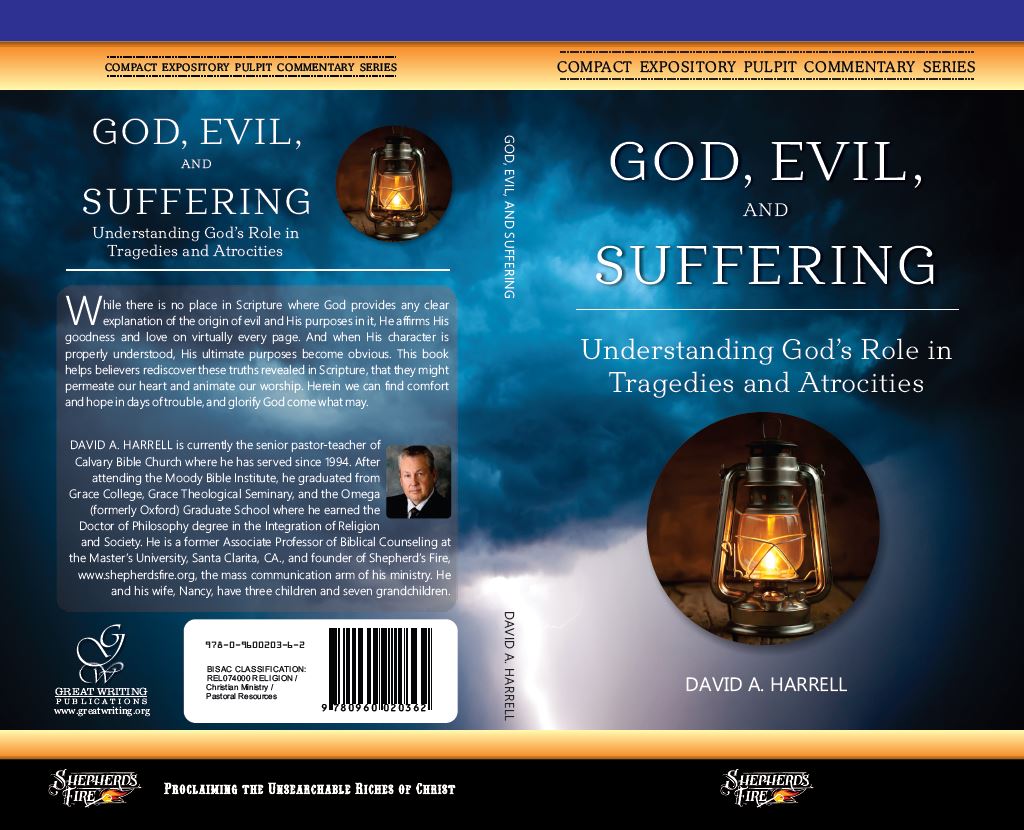
The post below is excerpted from God, Evil, and Suffering: Understanding God’s Role in Tragedies and Atrocities, a mini-book written by Dr. David A. Harrell, and published in the Compact Expository Pulpit Series, an imprint of Great Writing Publications and joint venture with Shepherd’s Fire Ministries.

Dave is currently the senior pastor-teacher of Calvary Bible Church where he has served since 1994. After attending the Moody Bible Institute, he graduated from Grace College, Grace Theological Seminary, and the Omega (formerly Oxford) Graduate School where he earned the Doctor of Philosophy degree in the Integration of Religion and Society. He is a former Associate Professor of Biblical Counseling at the Master’s University, Santa Clarita, CA., and founder of Shepherd’s Fire, the mass communication arm of his ministry. He and his wife, Nancy, have three children and seven grandchildren.

Many thanks to Dave for contributing this post. Readers are welcome to share this provided they include the content at the beginning and end of this post.


The Tragedy and Atrocity of the Crucifixion of Christ

Reflecting once again upon my short conversation with the Sunday School class, it was obvious to each of them that indeed the crucifixion of Christ was the greatest of all evils; that God was more, not less, glorified because of it and, as a result, sinners are able to experience more, not less, happiness. But several in the class struggled, and understandably so, with the idea of God’s providential working in the lives of evil men who, by His sovereign decree, independently chose by their own free will to act wickedly in participating in heinous acts. Most indicated that they had never thought about it that way.

Obviously, none of what happened caught God by surprise nor were the choices of those wicked men a violation of His sovereign will. This was evident in the prayer of Peter and John when they stated, “For truly in this city there were gathered together against Your holy servant Jesus, whom You anointed, both Herod and Pontius Pilate, along with the Gentiles and the peoples of Israel, to do whatever Your hand and Your purpose predestined to occur” (Acts 4:27).

Every Christian would do well to remember that the Father’s wrath of judgment against sin was poured out upon His Son and our substitute, Jesus Christ. Notwithstanding the responsibility of wicked men who cried out for Him to be crucified, Peter made it clear that God ordained His murder when he said, “this Man, delivered up by the predetermined plan and foreknowledge of God, you nailed to a cross by the hands of godless men and put Him to death” (Acts 2:23).

What an amazing concept: Jesus willingly chose to suffer and die on a cross because God ordained Him to do so. He was delivered up by the “predetermined plan.” The word predetermined is the Greek word horizo, meaning “to mark out a boundary beforehand,” from which we get our English word horizon. The word plan translates the Greek word boule used in Scripture to describe God’s will of purpose; that which He has designed, ordained, or decreed in eternity past. Sometimes this is referred to as His decretive or sovereign will. So Peter is literally saying that our sovereign God decreed that Jesus would die on the cross; it was His predetermined plan.

Furthermore, he attributes His sacrificial death to the “foreknowledge of God.” The word foreknowledge is the Greek word prognosis meaning “to foreordain”—a meaning that far exceeds the English concept of merely knowing something ahead of time. Moreover, grammatically speaking, since the term is in the instrumental dative case, it must be understood that Peter was actually saying, “It was God’s foreknowledge (foreordination) that was the sole cause or the means by which the men nailed Him to a cross.” Stated simply, Jesus did exactly what God ordained Him to do, yet those who called for His death and hung Him on the tree were responsible for His murder. Here again we see not only the mysterious convergence of God’s sovereignty and man’s responsibility, but also God deliberately ordaining an evil event to exist as a part of His plan and purpose to glorify Himself—the greatest act of evil in all of history: the murder of Jesus Christ.

Unlike the misguided musings of the Sunday School class, the testimony of Scripture plainly reveals that God is indeed sovereign over His creation. And though He is never responsible for sin, He does bring it about through the voluntary choices of men and He holds them accountable for their actions. Moreover, not only is God removed from actually doing evil, but never do we find an instance in Scripture of any act of evil surprising God and requiring Him to react with a “Plan B.”

In light of all this, it is obvious that no example can be found supporting the Arminian notion that God merely allowed the possibility for evil to exist in order to give His creatures freedom of choice, thereby guaranteeing that man’s choices would always be meaningful, as some would suggest. Instead, we see a sovereign God orchestrating His universe through the use of both good and evil.


This excellent little book (and several others in the series) may be purchased from online vendors such as Amazon HERE or directly from the author HERE.

Posted by Jim Holmes in Gospel, Guest Post, New & Noteworthy, Publishing Books Today, Theology, Windows on My Work, 0 comments
He To Rescue Me from Danger Interposed His Precious Blood

He To Rescue Me from Danger Interposed His Precious Blood

It’s a delight to share the labors of faithful authors. Roger Ellsworth is one such author, gifted with the ability to write seriously yet simply, and opening the Scriptures in a way that children as well as adults can understand. This guest post draws material from Roger’s Big Book of Coffee Cup Meditations, a book recently published, and available from bookstores or Amazon worldwide. More info HERE.


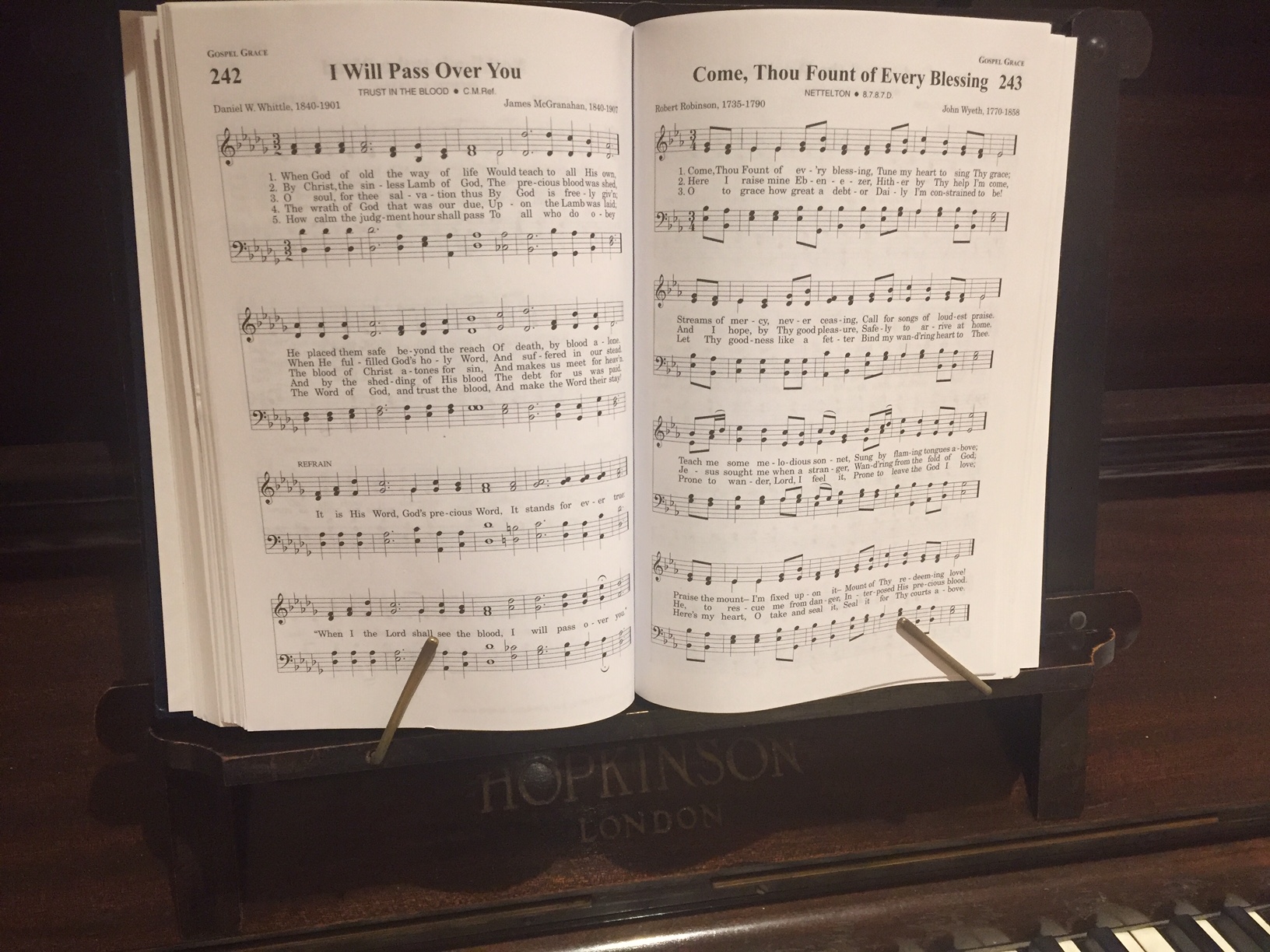
“He, to Rescue Me from Danger,
Interposed His Precious Blood”


From God’s Word, the Bible…

And if you call on the Father, who without partiality judges according to each one’s work, conduct yourselves throughout the time of your stay here in fear; knowing that you were not redeemed with corruptible things, like silver or gold, from your aimless conduct received by tradition from your fathers, but with the precious blood of Christ, as of a lamb without blemish and without spot. He indeed was foreordained before the foundation of the world, but was manifest in these last times for you.
1 Peter 1:17-20

Jesus sought me when a stranger,
Wandering from the fold of God;
He, to rescue me from danger,
Interposed His precious blood. . .
(Come, Thou Fount of Every Blessing, Robert Robinson, 1758)

These words take us to the heart of Christ’s saving work on behalf of His people. It was a matter of Jesus interposing His blood! That act of interposition makes His blood precious to every believer.

More about that in a moment! First, let’s think about that word “danger.” Frightening word! When we hear the word “danger,” we tend to think of the people and the things that threaten our wellbeing and happiness in this world. There is no shortage of them.

There is, however, another type of danger which is much worse than any posed by this temporal realm. It is the danger of experiencing the wrath of God in eternity. People these days like to play down that danger, but no fair reading of the Bible will allow us to do so. All are agreed that the Old Testament places a heavy emphasis on the matter, but we must not think that the teaching of God’s wrath is confined there. The same teaching is evenly distributed throughout the New Testament. It is in the Gospels (Matt. 3:12; 7:13-14; 22:13-14; 23:33; 25:30,41,46; Mark 9:42-29; Luke 16:19-31; John 3:36), in the epistles of Paul (Rom. 1:18-19; 2:5; 3:5; 4:15; 12:19; Eph. 2:3; 5:6), and in the other epistles as well (Heb. 10:27; 12:25-29; James 5:9; 1 Peter 4:17-18; 2 Peter 2:4-9).

It is the dominant theme of the book of Revelation (Rev. 6:16-17; 11:18; 14:10,19; 15:1,7; 16:1,19; 19:15; 20:11-15; 21:8; 22:11,15).

And for those who blissfully say: “Just give me the loving God of John 3:16,” the wrath of God is powerfully present in the word “perish” which is mentioned in that very verse.

We will never understand Christianity until we realize that it is all about rescuing people from this danger! Jesus came to this world for the express purpose of dealing with that danger.

God is holy. He cannot merely ignore our sins as if they never happened. He has to pronounce a sentence on them and also has to carry out that sentence. What is His sentence on our sins? It is His wrath, which is eternal separation from Himself in hell.

The glory of Christianity is that Jesus on the cross took the wrath that we deserve for our sins. There He “interposed” or inserted His blood between the wrath of God and guilty sinners. The word “blood” means that He poured out His life in death. To say He interposed His blood is to say He interposed Himself. On the cross He took the position between the wrath of God and guilty sinners. The wrath fell on Him, and there is now no wrath left for all who repent of their sins and trust in Him. John 3:36 puts it perfectly: “He who believes in the Son has everlasting life; and he who does not believe the Son shall not see life, but the wrath of God abides on him.”

But how could Jesus in the space of the six hours that He was on the cross (from 9:00 in the morning until 3:00 in the afternoon) receive an eternity’s worth of the wrath of God for all sinners who believe in Him? The answer lies in the special nature of Jesus. He was no ordinary man. He was the God-man, fully God, fully man at one and the same time. As God, He was an infinite person, and as an infinite person, He could receive in a finite length of time an infinite measure of wrath. In other words, Jesus as an infinite person could receive in a finite measure of time what we as finite people would receive in an infinite measure of time.

When we truly understand what Jesus did on the cross for sinners, we gladly respond to Robert Robinson’s phrase “precious blood” with a hearty “Yes!”

Posted by Jim Holmes in Current Issues, Friendship, Gospel, New & Noteworthy, Publishing Books Today, Reflections, Spirituality, Theology, Windows on My Work, Writing, 0 comments
Thinking About Ford v Ferrari

Thinking About Ford v Ferrari

Thinking About Ford v Ferrari

I am preparing this blog in consultation with my son, Matthew, aged sixteen years. He and I have prepared the text below, so some of the writing is entirely his. He and I saw the movie Ford v Ferrari late last year, and, because we found it thought provoking, I also took Sue to watch it a few weeks later. The movie is PG-13, largely as there is some fallen-world language.

It’s a sports action drama, a period setting from the early- to mid-1960s, the time I was growing up. It was fun to see how authentic the setting was—the style of cars, dress, décor, etc., though it did provoke discussion as to whether the Coca Cola bottles were quite authentic.

Characters and Plot

Based on the true story of Ford’s efforts to build a car that could rival Europe’s prime car, Ferrari, at the renowned twenty-four-hour, high-speed endurance race, the story line goes something like this:

Carroll Shelby is a former race-car driver who had to quit the sport because of a heart condition. Lee Iacocca, a member of the Ford Motor Company’s board of directors in charge of marketing, is challenged by Henry Ford (Junior) to find a way to appeal to an emerging youth demographic—baby boomers—who are attracted to more attractive, high-speed foreign cars. With Shelby, he thinks he has just the man for the job. Shelby decides to build a Ford car that will have capability to win the Le Mans race, and lobbies to have Ken Miles, an old friend, in the driver’s seat. Miles, a part-time racer, part-time auto-mechanic—a British man living in LA with his wife and son—is a hothead who is unwilling to help until the IRS come knocking. And then the need for finance propels him into the position.

After much corporate resistance, the Ford company reluctantly agrees to let Shelby and Miles apply their own ideas in a way that works, even if it does not conform to conventional company values. This climaxes in several thrillingly shot racing motor-racing sequences (the surround-sound effect in a cinema adds compellingly to the experience).

Well Produced

The movie would be entertaining but nowhere near as compelling if not for the strong character acting from Matt Damon and Christian Bale—and the good direction and cinematography that undergirds the production, courtesy the skills of people such as James Mangold. The witty, clever dialogue is the frosting on the cake, as my son insists!

A Key Quote

“There’s a point, seven thousand RPM, where everything fades. The machine becomes weightless, it just disappears. And all that’s left is a body moving through space and time. Seven thousand RPM, that’s where you meet it. It creeps up near you, and it asks you a question. The only question that really matters. Who are you?”

Thought Provoking

The movie elicited several thoughts:

  • This is a reminder of how the can-do American spirit can propel gifted people to excellence, notwithstanding several circumstantial challenges along the way.
  • Challenging the status quo—that is bucking the system—is sometimes the only way to get something done.
  • Life in this world is often fundamentally not fair! (And that is a profoundly biblical line of thought.) Without giving away anything in the movie, suffice it to say that not everyone is rewarded as he should be!
  • Facts can be as entertaining as fiction; the movie is well rooted in historical fact.

Matthew offered a parting summary: “A movie about American men doing manly, American things in the masculine America of the time.”

View the Trailer HERE: or below

Featured Image Credit: https://www.rottentomatoes.com/m/ford_v_ferrari/pictures

Posted by Jim Holmes in Creativity and Aesthetics, Family and Friends, Reflections, Spirituality, Technology, Worldview, 0 comments
Anyone Can Be an Author

Anyone Can Be an Author

Anyone Can Be an Author

Does that sound strange?

In my experience, almost everyone has a story to tell. But many people need help in coaxing the story to come out the right way. And then there are the others who have no difficulty in getting the story out, but they need some help in preparing the book for publication.

Amazon offers some remarkable tools to this end. It has been my pleasure to help in two projects in recent months where authors have elected to publish on Amazon’s Kindle Direct Publishing model. (KDP used to be called CreateSpace, but was renamed.) Simply stated, the program works something like this:

  • You already have an account with Amazon; to this, you add your bank details so that you may collect payment for sales of your forthcoming book(s).
  • You have prepared a book and your material is edited and ready for publication.
  • You upload the typeset text (or eBook) per Amazon’s requirements.
  • You upload the cover (specifications are given where necessary).
  • Some internal checks are run within the Amazon system; you have to wait patiently, but not for long!
  • Your book goes live and people from all around the world can buy or download a copy. All the revenues that come from this are yours to keep, though you have to be proactive in thinking of ways to stimulate the sales of your publications.

Authors have the choice of preparing an eBook first, or a print book first. I prefer to prepare the print book first and then create an eBook permutation.

Because some of the steps require particular care and professional expertise and experience, I either offered (or was asked) to help in the instances of the books below.

HABARI

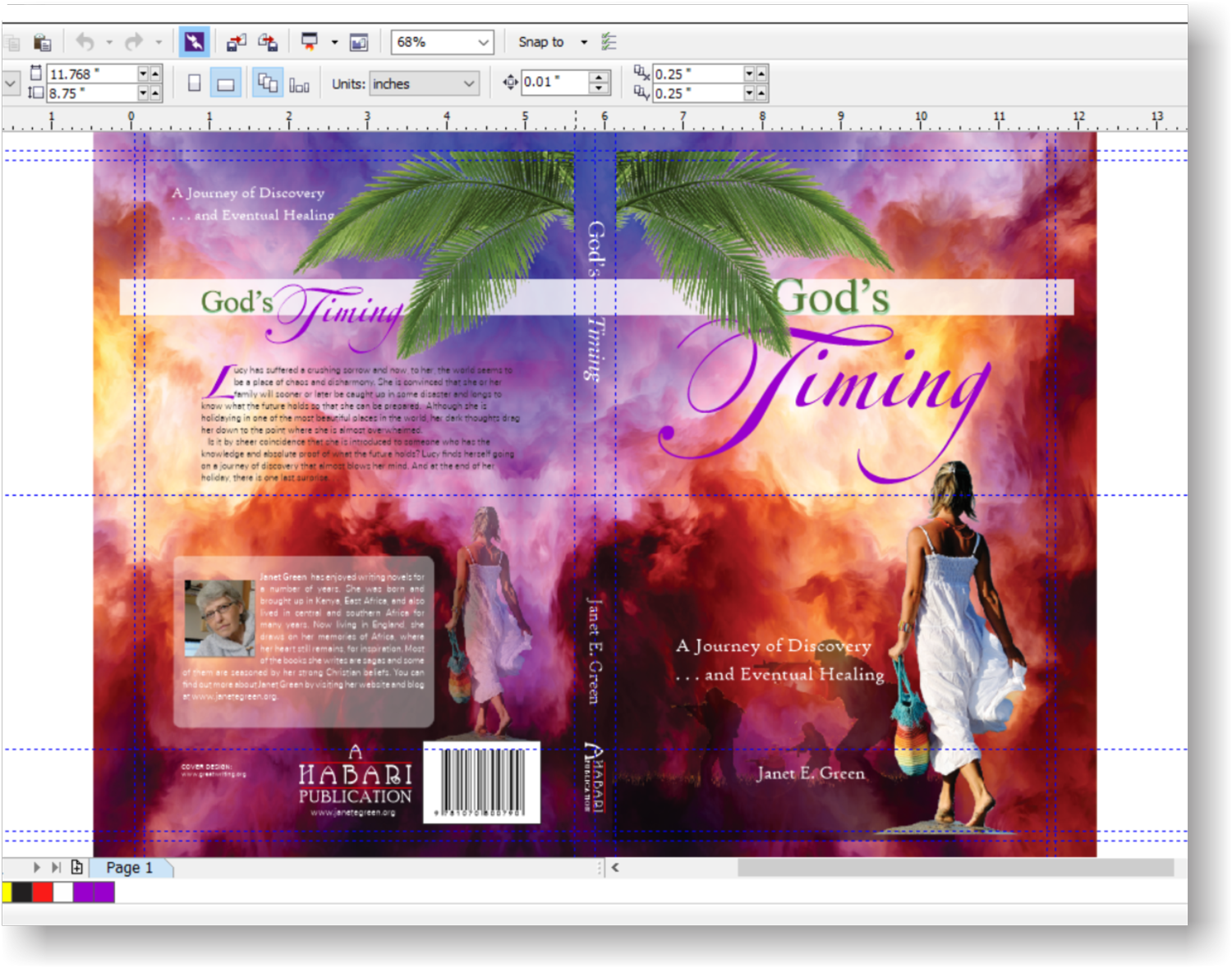
God’s Timing: A Journey of Discovery … And Eventual Healing (Janet E. Green)

Amazon Info HERE

Lucy has suffered a crushing sorrow and now, to her, the world seems to be a place of chaos and disharmony. She is convinced that she or her family will sooner or later be caught up in some disaster and longs to know what the future holds so that she can be prepared. Although she is holidaying in one of the most beautiful places in the world, her dark thoughts drag her down to the point where she is almost overwhelmed. Is it by sheer coincidence that she is introduced to someone who has the knowledge and absolute proof of what the future holds? Lucy finds herself going on a journey of discovery that almost blows her mind. And at the end of her holiday, there is one last surprise. . .

Janet Green has enjoyed writing novels for a number of years. She was born and brought up in Kenya, East Africa, and also lived in central and southern Africa for many years. Now living in England, she draws on her memories of Africa, where her heart still remains, for inspiration. Most of the books she writes are sagas and some of them are seasoned by her strong Christian beliefs. You can find out more about Janet Green by visiting her website and blog at www.janetegreen.org.

It was fun to prepare a publisher identity for this book–Habari Publications–in keeping with the African theme and identity of Janet Green’s writing and other publications.


OLD PATHWAYS

Martyn Ellsworth is a gifted writer whose imagination takes readers into historical fiction.

Journey to Prea: The Judayon Saga: Book 1 (Martyn Ellsworth)

Amazon info HERE

After years of darkness and foreign rule, the High King of Judayon prepares to bring about the long-awaited Restoration which will usher in a new era of freedom for his people. Expectations among Judayon’s faithful are raised as a man named Rulorn begins to proclaim the truth of the High King. In the capital city of Tamaton, four young people, Morikahn, Valroff, Razna, and Eramin, discover that the momentous events of their day will not leave them untouched. Amidst sweeping changes in the land, their lives will be imperiled, their friendship will be tested, and they will find themselves playing a role in the unfolding drama that they never envisioned.Journey to Prea is a work of Christian fiction inspired by the events of the Protestant Reformation.

Martyn Ellsworth is a preacher of the gospel of Jesus Christ, and he has served as a pastor for several years. He and his wife Rebekah are homeschooling their two young children. He enjoys listening to hymns and to sermons by Martyn Lloyd-Jones. He also loves to read The Chronicles of Narnia and books on theology and history. The Protestant Reformation and World War II are areas of particular interest to him.

It was also fun to prepare a publisher identity for this book–Old Pathways Publications–in keeping with the more old world feel and context of Martyn’s writings.


Cover design and identity is key in these kinds of projects and I am thankful for the authors and their creative input into determining how best to put together the various elements that were used! In particular, God’s Timing involved merging and airbrushing several elements into a composite graphic…


Featured Image: A CorelDraw screenshot from the preparation of the cover of God’s Timing. I have used Corel for many years and find it a versatile program for this kind of work.

Posted by Jim Holmes in Creativity and Aesthetics, Family and Friends, Heritage, Windows on My Work, Writing, 0 comments
Thinking about Books

Thinking about Books

Thinking about Books

Earlier in the year, I was challenged on Facebook to write notes on books that I have read and enjoyed. Here are some of the notes:

Pilgrim’s Progress

My sister Margaret Jones asked me to share books that I have found significant. So I thought of my copy of The Pilgrim’s Progress and am thankful for being persuaded to purchase the cloth-bound copy as long ago as 1981! Did you know that PP is said to be the second-best-seller to the Bible?


The President, the Pope, and the Prime Minister

Continuing to engage with my sister, Margaret Jones, who asked me to share books I have found significant, I thought this time that I would reference John O’Sullivan’s “The Pope, The President, and the Prime Minister.” While there are some aspects and interpretations in the book I would not agree with, I very much enjoyed the way in which O’Sullivan wrote so engagingly about three figures who had a remarkable influence on the world in the 1980s onward.


Hard Call

As I continue this short journey of reflection on books I have appreciated over the years, as requested by my sister Margaret Jones, a leadership book by the late John McCain comes to mind, “Hard Call.” I first read it about ten or more years ago, perusing the chapters with enjoyment as I was flying from place to place in my sales and marketing job. McCain engagingly teases out lessons of leadership from a wide range of people and events! You can dip into any of the chapters without reference to the others.


A Body of Divinity

Continuing the thought of books that have made a strong impact on me, as requested by Margaret Jones, I am thinking right now of the remarkable writing of Thomas Watson, a puritan minister, who prepared, inter alia, “A Body of Divinity.” It proved to be my first puritan book purchase, and came from The Bible Centre in Pietermaritzburg in 1982.
Watson is incredibly readable. You can find something quote-worthy at random on any page. Here is one:
“The wisdom of God is seen in making the most desperate evils turn to the good of his children. As several poisonable ingredients, wisely tempered by the skill of the artist, make a sovereign medicine, so God makes the most deadly afflictions co-operate for the good of his children. He purifies them, and prepares them for heaven. 2 Cor 4: I7. These hard frosts hasten the spring flowers of glory.”
Pictured is a later edition; I am pleased to own the hard-cover edition with muted red tones!


The Forgotten Spurgeon

As I continue this occasional journey through books that have been seminal in my thinking (at the request of Margaret Jones), today’s reflection is on Iain H. Murray’s “The Forgotten Spurgeon.” I received my copy as a gift from a good friend in the early 1980s but I only read it a few years later. And when I did, it was most helpful, relative to some issues I was working through. In it, Iain Murray provides a brief bio of CHS, the so-called (and well-deserved name) of the prince of preachers, 18th century Charles Haddon Spurgeon. Thereafter, Murray traces three noteworthy issues CHS faced: baptismal regeneration, the free offer of the gospel, and the Downgrade Controversy, a battle he faced with fellow Baptists who were crumpling and crumbling under the effects of modern, liberal, Bible-denying criticism. Spurgeon’s oft-repeated saying, as I recall from memory, “Fellowship with known and vital error is participation in sin,” should be axiomatic in today’s church, but sadly is not so. There is much to learn and apply from this excellent work, and I commend it as the right medicine for many of the issues modern believers are facing.


Surprised by Joy

Continuing the meander through thoughts about books I have enjoyed over the years, as requested by Margaret Jones, the next one that comes to my mind is one by C.S. Lewis. I was a university student at the time, battling my way through a mountain of indiscriminately varied books in an English syllabus–many of them patently boring, others full of filth. Then, in a secondhand store, I came across Lewis’ little gem, “Surprised by Joy.” The title is derived from a Wordsworth sonnet and of course also has peculiar significance to C.S.L. personally. Tracing his early life and influences, the author, with grace and freshness of style, paints beautiful word pictures of the earlier parts of his life, and how even in his rebellion, he found himself finding God and grace. What an oasis this book was to me in the wilderness of everything else I was reading at the time!


Look out for more book reflections as we move into 2020!

Posted by Jim Holmes, 0 comments
Some 2019 Projects in Review

Some 2019 Projects in Review

Some 2019 Projects in Review

The year has been one of steady focus on numerous editing, production, and publishing projects. Here, in no particular order of priority, are some insights into them…and this is by no means an exhaustive list!

Devotional Poems

IMMANUEL: Poems and Meditations on the Life of Jesus: This is the second in a series of Christmas books produced for EvangAlliance Publications, an 80 page full color cloth-bound book (with loose dust jacket), with beautiful poems and is truly a magnificent production. It is a companion to a book we worked on last year, INCARNATION Poems, also by poet Tom Worth. See more HERE.


The One Anothers of the New Testament

31 Ways to be a One Another Christian An email from Dr. Stuart Scott initiated this one. He and Andrew Jin had been working on a script that teased out the implications of what the New Testament has to say about “one another.” Would Shepherd Press be interested, he asked? Of course! The year was well progressed, and an ACBC deadline for launching the book was approaching with uncomfortable rapidity, so we accelerated the editing and production and were able to launch this excellent book in October. More info HERE.


365 Plus…

Daily Readings books have a special place in my heart. There are two that have been under my purview this year, both relatively late in the year.

The first is a compilation of the wonderful My Coffee Cup Meditations books by Roger Ellsworth and family. The more I thought about it, the more I wanted to get all twelve of these volumes into one big book. And the name that came to mind was simply The Big Book of Coffee Cup Meditations. It is truly a magnificent book, cloth-bound, nearly 800 pages in length. Roger writes on the back cover as follows:

Early mornings are very predictable for lots and lots of Christians. Roll out of bed, turn on the coffee pot, pour a cup, settle into a favorite chair and enjoy what is called “the daily devotional.” This usually consists of reading a passage from the Bible and a selection from a daily readings book. It concludes with prayer.

Believers who follow this pattern can go through a good number of devotional readings as the years go by. So they are always looking for new material—something to go along with their Bible and their coffee.

Hoping that I could be helpful in supplying the need for more of these kinds of readings, I gathered up some articles I had written and put them in a book—A Dog and a Clock. The idea was to supply brothers and sisters in Christ with enough devotions to carry them through one month. That quickly led to another book—The Thumbs Up Man—to carry “devotion-doers” through another month—and so on.

You can guess what happened after three or four books came out. There are twelve months in the year. So why not provide enough books to cover a year? Well, off we went and out the books came until there were finally twelve! Since these books were designed to go with the Bible and a good cup of coffee, it seemed right to call them My Coffee-Cup Meditations. Here are all twelve books in one big volume—372 readings in total!

More information HERE.

A good friend and former colleague connected me with new friends in TMAI–The Masters Academy International–in California who were in the final stages of preparing a large devotional book with multiple authors for publication. Would I help guide it through the process? The timing was tight, but the outcome is a beautiful (nearly 400 page) book, Declaring His Glory among the Nations. An edition of this book is available on Amazon HERE.


Esther: For Such a Time as This

Colin Mercer labored faithfully in Greenville, SC, for about a decade. I got to know him and appreciate his preaching at Faith Free Presbyterian Church. Friends there, Charles and Verta Koelsch, worked tirelessly on Colin’s sermon notes to prepare a very useful book on God’s care and providence as seen in the Old Testament book of Esther–with the title For Such a Time as This: The Sovereignty and Goodness of God in the Book of Esther. The outcome is a beautifully produced book of 176 pages. An edition of this book is available on Amazon HERE.


Tennessee Author Friends

Reggie Weems is a good friend in ministry in Eastern Tennessee, and we just released an excellent introduction to C.S. Lewis. In his series of “Ten Things About…”, the new The Man Who Made Narnia is a welcome addition to a man whose influence is truly remarkable. Also in preparation for 2020 is Good, But not Safe. The first title is available on Amazon HERE.

Dave Harrell, also a pastor in Tennessee, wrote a very good book on pastoral leadership. It was my pleasure to guide this through the editing and publishing process at Shepherd Press early in 2019. Soon after this was complete, Dave reached out to me with the thought of how his ministry, Shepherds Fire, could publish mini-books. After conferring on some strategic options, we came up with the idea of “The Compact Expository Pulpit Commentary Series,” small books of around 88 pages, each one packing a powerful punch in terms of both content and application. You can read more about Dave and his ministry HERE and obtain his books on Amazon as follows:

  • God, Evil, and Suffering HERE
  • God’s Gracious Gift of Assurance HERE
  • Our Sin and the Savior HERE


South African Connections

Dr. Francois Carr is based in Pretoria, South Africa, and has a global ministry in calling people to Christ and a consecrated walk with Him. One of his earlier books, Lead Your Family in Worship, had gone out of print. Francois reached out to me with the question: How could this book be brought back into print? Well, we found a way! We did a couple of prototype runs and the book has a few tweaks to go, and we expect to launch the agreed final version early in 2020. 

“It is an old but good saying that families which pray together stay together. This refreshingly up-to-date book on family worship is a valuable contribution to a much-neglected area of Christian practice. May God be pleased to bless its teaching to many.”–Rev. Maurice Roberts: Minister, Free Church of Scotland Continuing, Inverness, Scotland

The contents for Francois’ book are good for whetting the appetite:

Introduction
1: A Forgotten Command of God
2: Why is Family Worship Necessary? (A)
3: Why is Family Worship Necessary? (B)
4: Why Don’t Families Worship Together Anymore?
5: Common Excuses for Not Having Family Worship
6: How Do I Prepare Myself and My Family for Worship?
7: How Do We Worship as a Family?
8: What are the Foundations of Family Worship?
9: A Final Encouragement
Appendix 1: Where Do I Start?
Appendix 2: Suggested Format for Family Worship
Appendix 3: Suggesed Format for Family Worship
Appendix 4: An Example of Family Worship

The Man in the Gap Martin Holdt was my pastor for many years in South Africa. A good and godly man, the story of his life is more than worthy of being told. Friends Rex and Esta Jefferies in South Africa have labored hard to prepare a biography, and they and I have been exchanging files for a couple of years or more to get the text prepared for publication. We anticipate launching this book in the first quarter of 2020. Dr. Joel Beeke in the Foreword describes this as a “must-read” book!

Here are three fragments from Dr. Beeke’s  Foreword

I love good biographies of godly men. They are so stimulating, convicting, edifying, moving, challenging, and alluring. This is one of those biographies. It is a “must read” book—one that is so true to a godly pastor who lived, by God’s grace, wholly for Christ and out of love for the souls of people.

Martin Holdt was one of the very best friends in Christ Jesus that I have ever had. He was also one of the most godly people I have ever known. When he died so suddenly in the last week of 2011, I grieved as if I had lost a brother—because I did. He was like an older brother to me.

Read this book prayerfully, meditatively, and slowly. I pray God that Martin Holdt’s life story will move you to follow him insofar as he followed Christ.

Posted by Jim Holmes, 0 comments
2019 Arrives

2019 Arrives

Welcome to 2019!

Another Year Dawns. . .

THANKS BE TO GOD FOR HIS UNSPEAKABLE GIFT

The apostle Paul was almost overcome with a sense of the profound greatness of God’s gift—the gift of a Person, the Savior. In fact, he had to cobble together a word in the Greek language (in which he wrote his letter, 2 Corinthians) to express the fullness and wonder of what that gift was really like. Indescribably wonderful, ineffable, unable to be fully valued and appreciated—these are some of the meanings of this hard-to-translate adjective.

Who is the gift? None other than God the Son, the Second Person of the Holy Trinity. One fully equal with the Father and the Spirit, co-existent, co-eternal, without beginning and without end.

Why the gift? To secure the redemption of sinners. That’s ordinary people like you and me—folks ruined by the fall, born in a state of enmity with the one true and living God, and needing to be reconciled in a way that only God Himself could determine.

In our family we always enjoy giving and receiving gifts. But what a small thing this is in comparison with God’s gift to humanity in the Person of Jesus—and in the wondrous work He would do in reconciling us to God. As the saying goes, Bethlehem is really to establish the setting for Calvary. That’s where redemption was accomplished for all who would turn away from sin and trust in Jesus the Savior. Have you done that?

General Reflections from 2018

Pictures tell the story better than words…well, sometimes, that is. So, we thought that for 2018, we would let you have a glimpse into several aspects of the last twelve or so months. View the link below this text to see them!

In January, I made a very brief visit to the UK to visit my mother to be with her at her 91st birthday. It was also opportune to visit with my siblings, Janet and Markie, as well as a close friend, Raymond Zulu.

It was a busy year for Matthew with school (transitioning from being a freshman to a sophomore at Bob Jones Academy) and doing various musical and speech events.

Sue has continued to work at Greenville Presbyterian Theological Seminary as administrative assistant to Dr. Joseph Pipa.

Our travels as a family have not been extensive but have taken in a little of Tennessee. I had a brief visit to California to meet with work-related (Shepherd Press) clients, including Joni and Friends. We were delighted to have cousins, James and Frith Robb, visit with us from Scotland in March.

View a full report of our year with some additional pictures HERE or click on the image below.

Enjoy listening to Matthew’s rendering of Good Christian Men Rejoice from a recital at Bob Jones University late in 2018.

Posted by Jim Holmes in Family and Friends, Friendship, Memories, 1 comment
Why Work with Wood?

Why Work with Wood?

A Natural Aesthetic

I love the qualities that God has given wood: strength, beauty, functionality to mention just a few. One of the joys of living in the USA is the access to good lumber at relatively low prices. Over the years that America has been our home, I have been able to make a few things around the house, including a large shelving system for the den–most important for a bibliophile family such as ours!

My late father (pictured here) loved working with wood. In fact, he was the son of a saw miller. And while I am far from being a carpenter (I love the idea that Jesus was one), I think my father and his father both sent some of their woodworking genes my way…

As much as we live in a digital age, one of the needs all families face is how to manage and store papers. One of my values is functional elegance, so in some less-busy moments, I thought that perhaps something like a top-opening blanket chest could accommodate hanging files to accommodate our paperwork. And that set me on a course of, well, how could I easily (with the few tools I have at my disposal) actually make a chest from inexpensive lumber?

The Outcome

Den Shelving: A large, previous project

The outcome was fairly pleasing; I came up with a way to join pieces of wood, using glue and concealed screws, so as to ensure both strength and some elegance in the construction. Plywood can be flimsy, but, in a strong frame, it serves well, and it likes a nice coat of varnish–Pecan in this instance.

So, in odd spare moments, I set to the project on my screened porch, the only significant tool needing to be purchased being a tenon saw and a device to enable me to cut exact angles accurately. Everything else was served with a regular saw, drill, and screwdriver–oh, and yes, the glue and a few clamps that I used to ensure that everything was kept lined up correctly.

Take a look at the pictures in the slides following!

This slideshow requires JavaScript.

Posted by Jim Holmes, 0 comments
The Discipleship Process: How Iron Can Sharpen Iron

The Discipleship Process: How Iron Can Sharpen Iron

A Post I Prepared for Through the Lens of Scripture

(For more info, see HERE)

I remember when I was in Bible school how a visiting chapel speaker made this point one day in the form of a leading question: “Did Jesus say that we are to go into all the world and get people to make decisions?”

His thesis was that we are to make disciples, and not just converts. A disciple is, in essence, a learner or a student, as the origin of the Greek word for disciple presses us to understand it. Jesus had twelve such learners or students around Him, and He, the God-Man, discipled them in a wonderful way for three remarkable years as He spoke to them—and demonstrated their application—words of grace and truth.

Disciples or Decisions?

Monty Sholund: A picture probably taken in the 1980s.

“The discipleship process is a continuum,” remarked Monty Sholund, then principal of the Bible college I mentioned above. “You have not demonstrated your own discipleship until you have yourself made disciples. Turn with me to 2 Timothy 2:2,” he instructed as he leafed through his well-worn, leather-bound copy of the Bible. His head inclined at a slight angle, he spoke with a tone of gentle urgency: “You guys are emphatically not a part of that continuum until you have done what the apostle Paul said Timothy should do. Do you see it in the text?” His finger jabbed his Bible for emphasis. “It is in this process of not only being a disciple but forming other disciples that you will be blessed in the demonstration of your obedience to the Savior. And in the measure that you are responsive to introducing new converts—disciples—into the church, that is the measure of your success in demonstrating your obedience to the Great Commission as articulated by Jesus in Matthew 28.”

Monty’s words resonated strongly with me, and they do so nearly four decades later. Of course, our primary influence is with people is often in a face-to-face context, usually as we are in at least an informal relationship with them.

But the transfer of information, insight, knowledge, wisdom, convictions, values, and passion—and so much more—via the medium of writing comes in a significant second place to that which is primarily relational and personal and face-to-face in character. Books are wonderful facilitators of the disciple-making process!

Printed Media Has a Long Shelf Life

I love anecdotes such as how a scrap of paper that had been used for wrapping some food (and on which had been imprinted some catechism questions and answers) led to the “coincidental” conversion of the reader who just “happened” to be eating the food—and then there is the story of how a piece of literature that lay in the dust and darkness of an attic for over a generation was instrumental in blessing the eventual reader with the knowledge of God’s way of salvation, through repentance and faith, in the light of day when the attic was being cleaned out.

So, how can writing, editing, and book production further the process of disciple-making? Well, think with me of Francis Bacon, an English philosopher, who made these three comments:

  • Reading makes a full man;
  • Writing makes an exact man;
  • Conference (discussion) makes a ready man.

The first two in the triad suggest the deliberate use of words in the formation of character. We might like to paraphrase Bacon as saying something like this: “By reading the right kinds of materials, you will gain a breadth of knowledge and insight that is way beyond that of others, and that will be of benefit to you in your worldview and in the way in which you navigate the pathways of life; writing is similarly valuable: if you take the discipline seriously, you will consider carefully the meaning and value of words, and you will harness their power and effectiveness for communicating with laserlike clarity, economy, and efficiency.”

One of the titles for Jesus is the Word, the point made so emphatically by John in the opening comments of his Gospel. The words of the wise are as goads (Ecclesiastes 12:11). A goad is an instrument of prodding to propel others forward. Words used rightly can have the most amazing outcome with respect to motivation for behavior and transformation of values and character.

So, to join some dots together, think of it this way: In the continuum of discipleship, it is desirable that the learner make progress—progress in grace and knowledge of Christ, in particular (2 Peter 3:18)—progress in sanctification, becoming more like Jesus (the goal of our salvation), gaining greater understanding of how God’s Word and ways guide us along the pathway He has prepared for us, increasing in understanding of the whole counsel of God (Acts 20:27), becoming more discerning with respect to error and heresy (often so prevalent in Christian circles these days) and becoming increasingly useful in practical things like parenting, being a godly spouse, being an effective employee in the workplace, and an instrument of God’s grace in bringing the knowledge of the gospel to people in darkness, ignorance, and confusion.

And what better a way to facilitate this wonderful process of transformation than through words—words of godly people who themselves have imbibed God’s Word, and who have been equipped by Him not only to explain the content and concepts of that Word, but also to draw clear lines of application from the body of Scripture to the real circumstances of life, whether in helping shape attitude or transform behavior!

Valuable Values

With respect to Shepherd Press, the kinds of authors we love to see investing into writing and publishing books that will enrich the continuum of discipleship are those who embrace the three core values of the publishing mission of Shepherd Press. This means that whatever is seriously considered for publication should be:

  • Life changing
  • Heart driven
  • Gospel centered

Publishing occupies the remarkable position at the intersection of the two disciplines of reading and writing. I so appreciate the words of the godly Richard Baxter, a Puritan pastor, who made the point that it was not in the reading of many books that benefit was to be found, but in the careful reading and consideration of the right ones.

At Shepherd Press, being involved in the publishing process provides remarkable opportunities to envision—and to think through—how the material that is being considered for publication, and is subsequently in the process of developmental editing, will challenge and enrich the minds and hearts of readers.

I often make the point that the publishing process is incomplete until the books have… wait for it… not merely been produced, and, no, not even been sold with money in the bank to prove it, but have actually reached into the hearts and minds of the readers they are meant for.

Please pray for us at Shepherd Press—and pray for all publishers committed to the model of preparing and presenting excellent, scripturally based materials—not just for the success of the publishing process, but to the end that Christ might be glorified, sinners saved, and a robust paradigm of Word-based discipleship might come about as a result.

Are you a disciple-maker? Suggest two or three areas in your calling (whether at work, at home, or at school / college / university) in which you could naturally foster a disciple-making mindset with potentially good outcomes.


Jim Holmes is a freelance publishing consultant who serves Shepherd Press in editorial and related matters. You may find out more about him at www.blogspot52.com or follow him on Twitter at https://twitter.com/jameswholmes1


Thanks to Shirley Crowder of Through the Lens of Scripture (for whom this post was originally prepared) to share this on my own site.


Posted by Jim Holmes in Family and Friends, Gospel, Publishing Books Today, Spirituality, Writing, 0 comments